
“Last updated: August 2026”
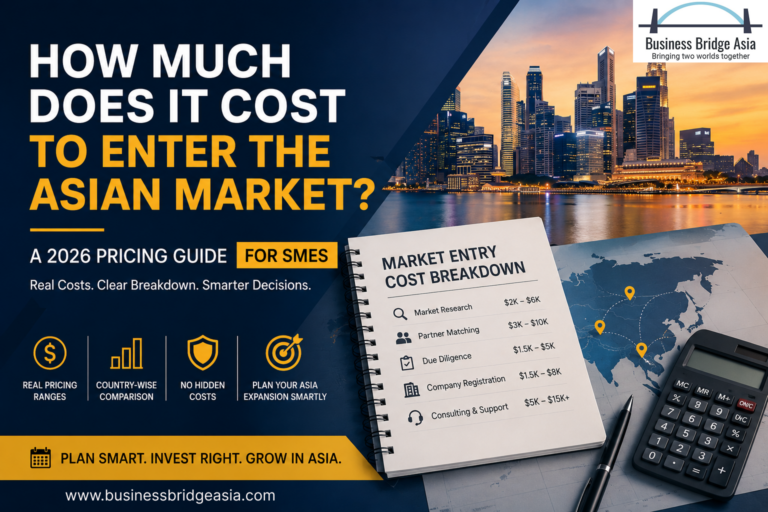
In short: Asia market entry pricing for SMEs typically ranges from $8,000 to $50,000+ depending on country, business model, and scope. This guide breaks down real Asia market entry consulting pricing by service and by country.
Best suited for: SMEs and growing companies budgeting their first Asia expansion. If you already have a defined budget and just need execution, request a free custom quote directly.
If you are seriously considering expanding into Asia, one of the first questions you need answered is how much does it cost to enter the Asian market. It is a fair question — and frankly, one that too many consulting firms avoid answering directly. Vague pricing leads to vague decisions, and vague decisions are how SME budgets get wasted on the wrong service at the wrong time.
“If you’re comparing pricing Asia market entry firms typically quote, the ranges below reflect real SME engagements — not inflated ‘starting from’ numbers designed to get you on a call.”
This guide breaks down Asia market entry consulting pricing in plain terms — what each service typically costs, what drives the price up or down, and how to think about budgeting for your specific market. We’ll use real examples across Vietnam, Thailand, Bangladesh, and the Philippines to make the numbers concrete.
How much does it cost to enter the Asian market?
Asia market entry costs for SMEs typically range from $8,000 to $50,000+ depending on the country, business model, and services required. Company registration alone ranges from $1,500–$8,000. Local partner matching typically costs $3,000–$10,000. Due diligence on partners ranges from $1,500–$5,000. Full market entry packages — including strategy, partner matching, and on-the-ground support — generally range from $15,000–$40,000 for a single country.
Foreign direct investment into ASEAN markets has remained resilient even as global FDI flows have slowed, according to ASEAN Secretariat data — one reason more SMEs are budgeting for market entry now rather than waiting.
Thailand has been a major manufacturing destination for decades — home to one of Southeast Asia’s largest automotive industries, a thriving electronics sector, and world-class food processing facilities. The Eastern Economic Corridor (EEC) — Thailand’s flagship industrial development zone — is attracting billions in investment across next-generation industries including electric vehicles, aerospace, digital, and medical technology.
Thailand sits at the geographic centre of mainland Southeast Asia — bordering Myanmar, Laos, Cambodia, and Malaysia, with convenient access to Vietnam, Singapore, and the rest of ASEAN. For companies seeking a regional hub to serve the broader ASEAN market, Thailand’s location, logistics infrastructure, and connectivity make it a natural choice.
Thailand’s Board of Investment (BOI) is one of Asia’s most active investment promotion agencies. BOI-promoted companies benefit from corporate income tax exemptions of up to 8 years, import duty exemptions on machinery and raw materials, and rights to own land and bring in foreign experts. The BOI application process is well-structured and accessible for foreign SMEs.
Thailand’s middle class has expanded significantly over the past two decades. Consumer spending on healthcare, education, financial services, lifestyle products, and technology is rising steadily. Bangkok ranks among Southeast Asia’s most sophisticated consumer markets — and secondary cities like Chiang Mai, Phuket, and Khon Kaen are growing fast.
Costs vary meaningfully by country. Vietnam and Bangladesh tend to have lower registration and labour costs than Singapore or Thailand. The Philippines sits in a useful middle ground — English-language business environment reduces translation costs, while overall costs remain competitive compared to Singapore.
A representative office for market research costs significantly less than setting up a manufacturing operation or a full subsidiary with local staff. Distribution and sales models fall somewhere in between. Defining your model early is the single biggest lever on your total budget.
Some companies need only a market assessment to decide if Asia expansion makes sense at all — a relatively low-cost engagement. Others need the full journey: strategy, partner matching, due diligence, registration support, and ongoing local presence. The wider the scope, the higher the investment — but also the lower the risk of costly mistakes.
If your business model depends on a local partner — a distributor, manufacturing partner, or joint venture — partner matching and due diligence become essential line items. Skipping due diligence to save a few thousand dollars is one of the most common false economies in Asia market entry, often costing far more in failed partnerships later.
Loading..........
The Data is Not Available
Note: these are general ranges for a single-country market entry for an SME. Multi-country expansions, complex manufacturing setups, or highly regulated industries (finance, healthcare, defense) typically fall toward the higher end or beyond these ranges.
For companies exploring Philippines market entry strategy for US companies, cost is often a pleasant surprise compared to other Asian markets. Because English is a primary business language in the Philippines, translation and cultural advisory costs are typically lower — often 30–50% less than in non-English-speaking markets. This makes the Philippines a cost-efficient entry point for US companies expanding business to Southeast Asia, particularly for service-based businesses, outsourcing operations, and consumer goods distribution.
Companies considering doing business in the Philippines for SMEs should budget for company registration through the Securities and Exchange Commission (typically $1,500–$4,000 for a standard setup), and Philippines partner matching services if working with local distributors or manufacturing partners (typically $2,500–$7,000 given the relatively lower complexity of English-language vetting).
For companies pursuing a Philippines business expansion consulting engagement focused on outsourcing — IT services, call centres, or back-office operations — costs can be notably lower than manufacturing-focused entries in Vietnam or Bangladesh, since the Philippines outsourcing ecosystem is mature and well-documented.
Before committing significant budget, validate that the opportunity is real. A market research and assessment engagement tells you whether demand exists, who your competitors are, and what realistic pricing looks like. This is the lowest-risk, highest-value early investment — and it often determines whether you proceed at all.
Once validated, this phase covers partner matching, due diligence, and company registration. This is where most of the “infrastructure” of your market entry gets built — the legal entity, the local relationships, and the compliance foundation.
This covers the first 3–6 months of on-the-ground execution support — the period where most market entries either gain traction or stall. Budget for ongoing local support during this phase; it is consistently the highest-return spend in the entire process.
Much of affordable market entry consulting Southeast Asia comes down to structure. Large consulting firms build their pricing around teams of consultants billing by the hour, often from outside the target market. Business Bridge Asia’s model is different — we have local teams already established in Vietnam, Thailand, the Philippines, Bangladesh, and across the Pacific, which means lower overhead and pricing that reflects local market realities, not Western consulting rates applied to an Asian engagement.
We also price modularly. If you only need partner matching, you pay for partner matching — not a bundled package that includes services you don’t need. For SMEs with defined budgets, this modular approach often makes the difference between Asia expansion being feasible this year versus being pushed back indefinitely.
Every business is different — and so is every market entry budget. Tell us about your business, your target market, and your goals, and we’ll give you a clear, honest cost breakdown for exactly what you need. No generic packages, no pressure — just real numbers for your specific plan.