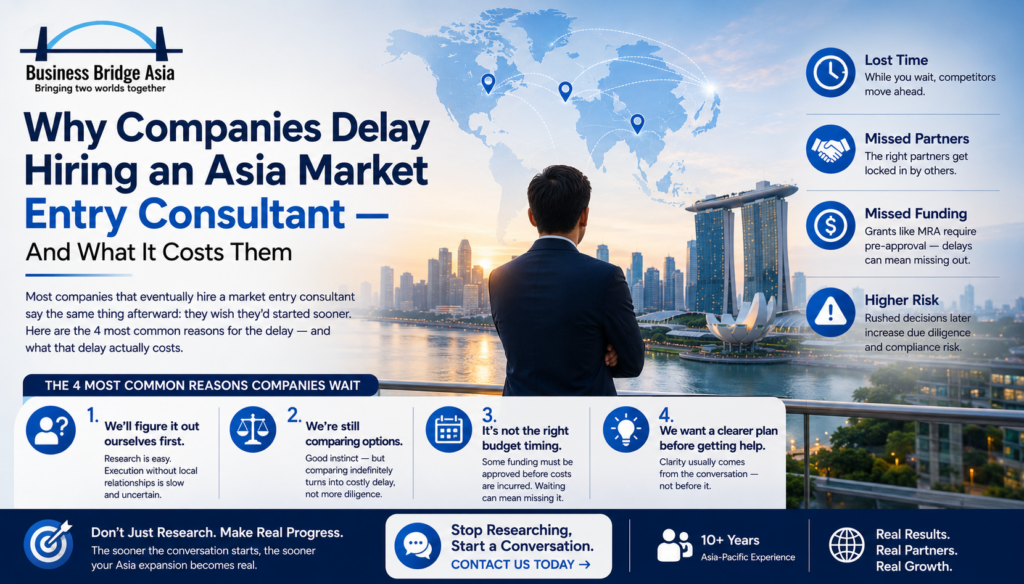
Why Companies Delay Hiring an Asia Market Entry Consultant
And What That Delay Actually Costs Them
In short: Most companies that eventually hire a market entry consultant spent months researching first — and almost all of them say afterward they wish they’d started sooner. This isn’t a pitch to rush a decision. It’s an honest look at what “we’ll decide later” usually ends up costing.
If you’ve read our guides on Asia Due Diligence Guide, pricing, or case studies and still haven’t reached out, you’re not alone — and you’re probably not being unreasonable. Asia market entry is a real commitment, and taking it seriously is the right instinct. But there’s a difference between careful evaluation and open-ended delay. Here are the four reasons we hear most often, and what usually happens as a result of each one.
“We have someone on the team who can handle this — we don’t need outside help yet.”
This usually works fine for research. It rarely works for execution. The gap isn’t information — it’s local relationships. A partner introduction that takes a consultant two weeks through an existing network can take an internal team months of cold outreach, and by the time you’ve built those relationships from scratch, a competitor with local support may already be operating.
2. "We're still comparing options — not ready to commit."
“We want to make sure we choose the right firm before we move forward.”
This is genuinely a good instinct — our own guide on how to choose an Asia market entry consulting firm exists because this matters. The problem isn’t comparing options; it’s comparing indefinitely. If you’ve already read the criteria and a firm meets them, further delay isn’t more diligence — it’s just delay.
3. "It's not the right budget timing."
“We’d rather wait until next quarter when budget is confirmed.”
Fair, but worth checking first: some funding, like the Singapore MRA Grant Guide, must be applied for and approved BEFORE you incur costs — not after. Waiting a quarter can mean missing funding that would have offset a meaningful share of the engagement, not just delaying the spend.
4. "We want a clearer plan before we bring in outside help."
“We’ll reach out once we know exactly what we need.”
In our experience, this is often backward — the plan usually gets clearer once you’re talking to someone who’s done this before, not before. Companies waiting for a fully-formed plan often stay in that holding pattern far longer than they expected, simply because the clarity they’re waiting for doesn’t show up until the conversation actually happens.
What are the real costs of delaying Asia market entry?
Delaying Asia market entry typically costs three things beyond lost time: missed funding windows that require pre-approval before costs are incurred, competitors establishing local partnerships first, and increased due diligence risk from rushing decisions later to make up for lost time. None of these show up on a spreadsheet until after they’ve already happened.
The companies we’ve worked with who moved quickly, and the ones who waited a year, usually didn’t have different plans — they had different timelines for the same plan. The ones who waited almost always say the same thing afterward: they wish they’d started the conversation sooner, even if they weren’t ready to sign anything yet.
Real Results From Companies That Didn't Wait
A US freight forwarding company secured 100% foreign ownership in the Philippines and Indonesia after another firm couldn’t get it done — they moved on that opportunity instead of waiting for a “perfect” moment. A Thailand-based distributor doubled international sales within a year of engaging support, rather than continuing to handle limited overseas representation alone. Read the full real, sourced case studies.
Frequently Asked Questions
No schema found.
Stop Researching, Start a Conversation
You don’t need a fully-formed plan to reach out — that’s often exactly what the first conversation helps you build. No obligation, no pressure.