
What is due diligence in Asia market entry? Due diligence in Asia market entry is the process of verifying a prospective business partner, distributor, or supplier before signing an agreement — including checking company registration, financial standing, litigation history, and reputation. It typically takes 2-4 weeks and is the single step most foreign companies underestimate before committing capital to a new Asian market. |
Before signing any partnership agreement in Asia, due diligence Asia checks are what stand between a well-founded expansion and a costly mistake. Business Bridge Asia provides due diligence Asia services covering financial checks, reputation verification, and regulatory standing — for companies entering Vietnam, Thailand, Indonesia, Cambodia, and across the wider Asia-Pacific region.
Why is due diligence important before entering an Asian market?
Due diligence is critical because company registration, financial statements, and reputational information in many Asian markets aren’t as standardized or publicly accessible as in the US or Europe. A partner, distributor, or supplier can look credible on paper while carrying undisclosed debt, unresolved litigation, or a damaged reputation locally — problems that are far cheaper to uncover before signing than after capital has already been committed.
Foreign companies that skip formal verification often rely on a partner’s own representations, a website, or a single introductory meeting — none of which reliably surface financial or legal red flags. A structured due diligence process closes that gap before it becomes an expensive problem.
What does a due diligence check in Asia typically include?
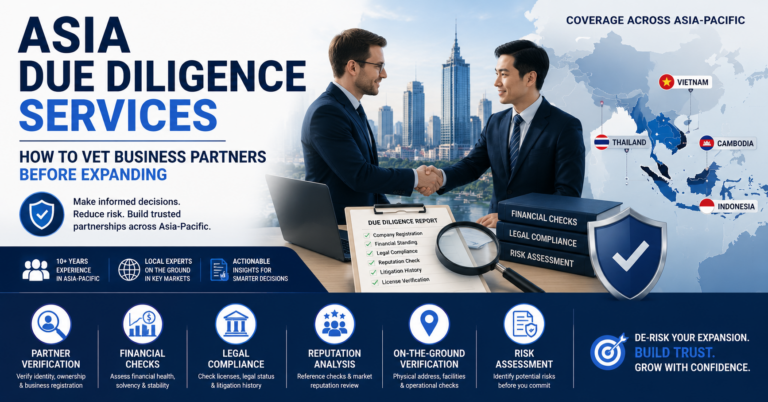
Asia Pacific due diligence services typically cover four areas: financial background checks (solvency, debt, banking relationships), legal and regulatory standing (business registration, licensing, litigation history), reputation and reference checks (industry standing, past business relationships), and physical verification (confirming an operating address and facilities actually exist, where relevant).
Verifying a prospective partner’s solvency, outstanding debt, and banking relationships helps confirm they can actually deliver on the financial commitments of a partnership or distribution agreement.
Confirming valid business registration, required sector licenses, and checking for unresolved litigation or regulatory actions protects against partnering with an entity that isn’t legally positioned to operate as represented.
Speaking with other companies that have worked with a prospective partner — not just the references they provide — surfaces patterns that a clean company registration search won’t show.
For manufacturing, distribution, or office-based partnerships, confirming that a listed facility actually exists and matches what was represented is a basic but frequently skipped step.
What does Vietnam due diligence cover?
Vietnam due diligence services verify business registration with Vietnamese authorities, financial standing, and litigation history for prospective partners, distributors, or suppliers — a step Business Bridge Asia recommends before finalizing any Vietnam partnership, given how relationship-driven early introductions can be.
Companies exploring Vietnam due diligence services can also review our full Vietnam due diligence services offering and our dedicated Vietnam Business Advisory guide for ongoing partner management after the initial check.
Thailand due diligence checks cover business registration with the Department of Business Development, financial standing, and reputation verification — particularly important for distribution and joint-venture partnerships, where Thailand due diligence services are most commonly requested alongside initial market entry planning.
Indonesia’s decentralized regulatory environment makes local verification especially important — Indonesia due diligence services from Business Bridge Asia cover both national-level company registration and province-level licensing checks where relevant.
How do I vet a business partner in Asia step by step?
Vetting a business partner in Asia typically follows five steps: (1) define what you need to verify based on the type of partnership, (2) confirm company registration through official government channels, (3) check financial standing and solvency, (4) conduct reference calls with other companies that have worked with the partner, and (5) complete physical verification of facilities where relevant. Most engagements complete this process in 2-4 weeks.
▸Step 1 — Define What You Need to Verify: A distribution partner, a manufacturing supplier, and a joint-venture co-owner each carry different risk profiles — scope the check accordingly rather than running a generic search.
▸ Step 2 — Company Registration Check: Confirm the entity is legally registered, in good standing, and licensed for the relevant sector.
▸Step 3 — Financial Standing: Review solvency, outstanding debt, and banking relationships to confirm the partner can meet its financial commitments.
▸ Step 4 — Reference Calls: Speak directly with other companies that have worked with the partner, rather than relying solely on references the partner provides.
▸ Step 5 — Physical Verification: Where the partnership involves a physical facility, confirm it exists and matches what was represented before finalizing any agreement.
How much does Business Bridge Asia charge for due diligence in Asia?
Business Bridge Asia’s Asia Pacific due diligence services typically range from $1,500 to $5,000 depending on scope and the number of countries covered, with most engagements completing within 2-4 weeks. Pricing is scoped to the specific verification required rather than a flat one-size-fits-all rate.
Business Bridge Asia’s Asia Pacific due diligence services combine local attorney networks with on-the-ground verification across Vietnam, Thailand, Indonesia, Cambodia, and other Asia-Pacific markets, so you get a single point of contact rather than coordinating multiple local researchers yourself.
Evaluating a partnership alongside a broader market entry plan? These guides cover related topics:
▸Vietnam Business Advisory Services — for ongoing partner management after initial due diligence.
▸ Asia Market Entry Cost Guide 2026 — full pricing breakdown including due diligence costs across the region.
▸How to Enter the Cambodia Market — includes Cambodia-specific partner vetting considerations.
A: Costs typically range from $1,500 to $5,000 depending on scope and the number of countries covered. Business Bridge Asia scopes fees to the specific verification required — a free consultation is the fastest way to get an accurate quote.
A: Most due diligence engagements in Asia take 2-4 weeks, depending on the complexity of the partner’s structure and how many jurisdictions are involved.
A: At minimum, confirm business registration certificates, recent financial statements, litigation records, and any required sector-specific licenses before signing an agreement.
A: Much of the process — registration checks, financial record review, reference calls — can be done remotely. Physical verification of facilities, where relevant, typically requires an on-the-ground visit, which Business Bridge Asia coordinates through local teams.
A: Findings range from minor (outdated licensing paperwork) to serious (undisclosed litigation or financial instability). Business Bridge Asia presents findings clearly so you can decide whether to proceed, renegotiate terms, or walk away before any capital is committed.
A: It isn’t legally required in most cases, but it is strongly recommended before any partnership, distribution, or joint-venture agreement — the cost of due diligence is typically a small fraction of the cost of a failed partnership.
Whether you’re finalizing a distribution agreement or evaluating a joint-venture partner, Business Bridge Asia can verify who you’re dealing with before you sign anything.
Tell us about the partnership you’re evaluating and we’ll respond within 24 hours.
Start Your Due Diligence — Get a Free Quote → businessbridgeasia.com/contacts/