
What Foreign Brands Need to Know Before Signing a Master Franchise
By Business Bridge Asia Team | Southeast Asia Franchise Expansion
In short: Southeast Asia’s franchise market is genuinely booming — projected to hit $78 billion by the end of 2026, growing faster than North America or Europe. But franchise rules vary sharply by country, and most foreign brands underestimate how much local partner selection matters before they ever get to the contract stage.
Best suited for: foreign brands — F&B, retail, services, or technology-enabled concepts — evaluating franchise or master-franchise expansion into one or more Southeast Asia markets, and prioritizing local partner relationships over a full standalone entity from day one.
What does franchise expansion into Southeast Asia typically involve?
Franchise expansion into Southeast Asia typically involves selecting a market and entry structure (direct franchise vs. master franchise), preparing country-specific disclosure and registration documents, and identifying vetted local partners or master franchisees — a process that varies meaningfully by country given differing regulatory requirements across the region.
Why is Southeast Asia attracting so much foreign franchise investment in 2026?
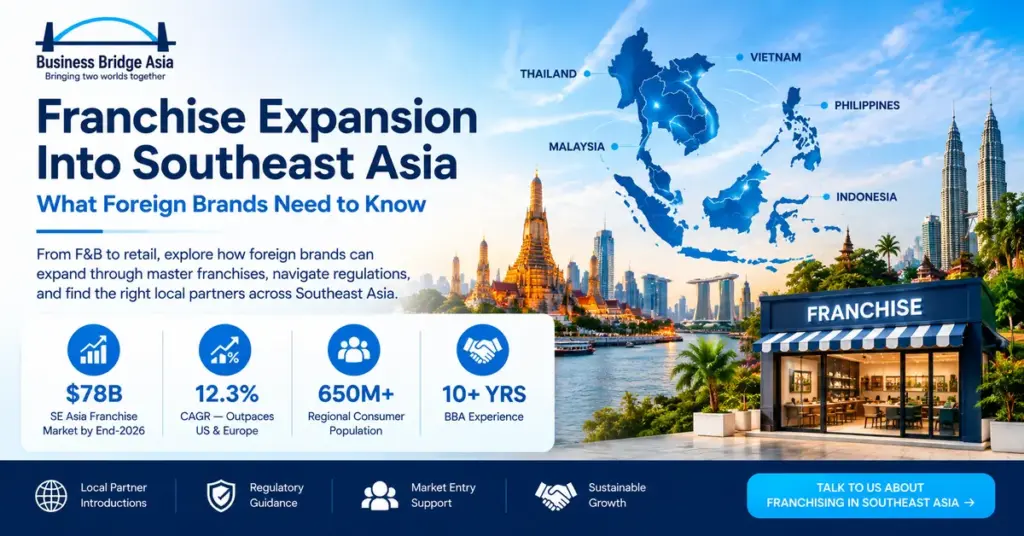
Southeast Asia’s franchise market is projected to reach $78 billion by the end of 2026, growing at a 12.3% CAGR — faster than North America (5.1%) or Western Europe (4.8%) — driven by a young, urbanizing population of over 650 million, rising middle-class spending, and mall-led retail development across the region. F&B remains the most active category, with quick-service and fast-casual concepts (including coffee, bubble tea, and Korean and Japanese cuisine) leading the way, though education and wellness franchises are also gaining ground.
This isn’t a niche trend — it’s a fast-moving category. We’re seeing this firsthand, with inbound interest from brands across F&B and other sectors looking specifically for local partner introductions rather than a full standalone entity from day one.
Do franchise regulations differ significantly across Southeast Asia countries?
Yes, significantly. The Philippines mandates Franchise Disclosure Document (FDD) registration before franchising activity begins. Indonesia restricts foreign equity in F&B franchise structures specifically, often requiring a local majority partner. Thailand requires local entity registration before franchise operations can begin. Treating Southeast Asia as one uniform market is one of the most common — and costly — mistakes foreign brands make.
Philippines — Requires Franchise Disclosure Document (FDD) filing before franchise activity can legally begin.
Indonesia — Restricts foreign equity specifically in F&B franchise structures — most brands need a local majority partner in this category.
Thailand — Requires local entity registration before franchise operations can begin — this can’t be skipped even for a master-franchise structure.
For a deeper look at Vietnam specifically, our Vietnam market entry page covers the broader regulatory landscape franchise brands also need to navigate there.
What’s the difference between a master franchise and a direct franchise in Southeast Asia?
A master franchise grants a local partner exclusive rights to develop and sub-franchise a brand across an entire country or territory, in exchange for a territory fee and ongoing royalties — this is the structure behind most large cross-border franchise expansions into Southeast Asia. A direct franchise, by contrast, involves the brand licensing individual units without a regional development partner in between, which offers more control but requires far more local operational involvement from the franchisor.
Most brands entering Southeast Asia for the first time choose the master franchise route specifically because it front-loads local market knowledge and relationships — the exact gap that partner-matching support is designed to close.
Choosing the right master franchisee matters as much as choosing the right country. Before signing any agreement, verify a prospective partner’s business registration, financial standing, and existing operational track record — not just what they present in a pitch deck. Our Asia Due Diligence Guide covers the full verification process we recommend before committing to any partnership, franchise or otherwise.
Third-party validation matters more than franchisor claims alone — buyers and partners increasingly expect transparent financial modeling and proof of ongoing support beyond the signing ceremony, not just brand recognition.
Not every market entry consultant has direct experience with franchise-specific structures and disclosure requirements. Our guide on how to choose an Asia market entry consulting firm covers the broader evaluation criteria — for franchise expansion specifically, also ask whether a firm has handled FDD-equivalent filings and master-franchisee vetting before, not just general company registration.
Business Bridge Asia has helped clients secure complex ownership and partnership structures where other firms couldn’t, including full foreign ownership in Philippines market entry consulting engagements after a previous firm fell short. Read the full real, sourced case studies.
Whether you’re evaluating your first market or comparing several, we can help you find and vet the right local partner.