How to Enter the Indonesia Market: A Complete Guide for Foreign Companies

Indonesia is Southeast Asia’s largest economy and the world’s fourth most populous country — a market of 280 million people with one of the most dynamic growth stories in all of Asia. For foreign companies considering Indonesia business expansion, the opportunity is substantial. But so are the complexities. Indonesia’s regulatory environment, cultural diversity, geographic spread across 17,000 islands, and the critical importance of local partnerships make it a market that rewards careful preparation and punishes hasty entry.

This guide gives you a practical, honest roadmap for doing business in Indonesia as a foreign company — from the initial market assessment through to legal setup, partner matching, and on-the-ground execution.
How do I enter the Indonesia market as a foreign company?
To enter the Indonesia market, foreign companies should follow six steps: (1) define your market entry objective — manufacturing, distribution, or services; (2) conduct Indonesia market research to validate demand; (3) understand Indonesia’s regulatory environment, including the Negative Investment List (DNI) and BKPM registration; (4) identify and vet a trusted local Indonesian partner; (5) register your legal entity through BKPM or OSS; and (6) execute with on-the-ground support in Jakarta, Surabaya, or your target region. Business Bridge Asia provides end-to-end Indonesia market entry consulting for foreign SMEs.
Business Bridge Asia has been operating across Indonesia since our founding. Our local team is based in Jakarta — with networks across Surabaya, Bali, and the major industrial corridors. We have supported SMEs from the United States, Singapore, Australia, and Europe through every stage of Indonesia market entry, across manufacturing, consumer goods, technology, and professional services.

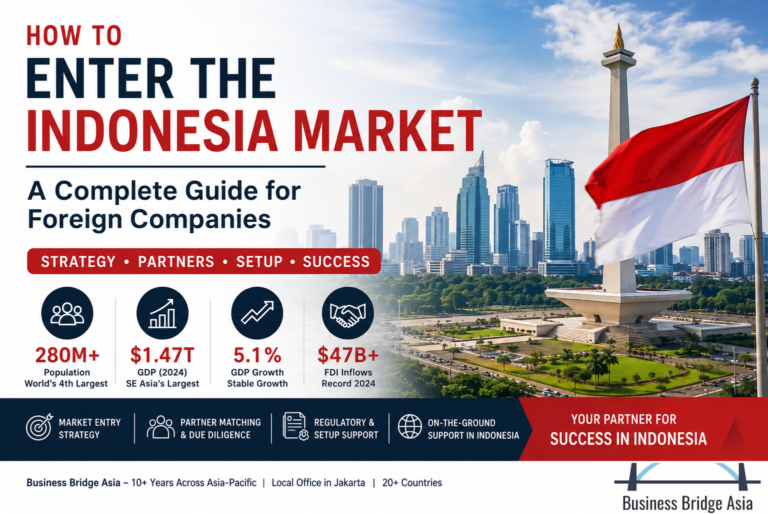
280M+

Population
World's 4th largest

$1.47T

GDP (2024)
SE Asia's largest

5.1%

GDP Growth
Stable annual growth

$47B+

FDI Inflows
Record 2024 level
How to Enter the Indonesia Market BusinessBridgeAsia

Why Indonesia? The Business Case for Foreign Companies

Why should foreign companies consider Indonesia for market entry?
Indonesia is Southeast Asia’s largest economy with a GDP of $1.47 trillion and a population of 280 million — making it one of the world’s largest consumer markets. Indonesia’s growing middle class, rapid digital adoption, abundant natural resources, and government-led investment drive through BKPM make it a priority destination for foreign companies seeking Southeast Asia exposure. Key sectors include manufacturing, consumer goods, technology, energy, and financial services.

Southeast Asia's Largest Economy

Indonesia’s middle class has expanded dramatically over the past two decades and continues to grow. Consumer spending on healthcare, education, financial services, technology, and lifestyle products is rising steadily. E-commerce adoption is among the fastest in Southeast Asia — making Indonesia an increasingly attractive destination for consumer-facing businesses.

280 Million Consumers — A Growing Middle Class

Indonesia’s middle class has expanded dramatically over the past two decades and continues to grow. Consumer spending on healthcare, education, financial services, technology, and lifestyle products is rising steadily. E-commerce adoption is among the fastest in Southeast Asia — making Indonesia an increasingly attractive destination for consumer-facing businesses.

Strategic ASEAN Gateway

Indonesia sits at the heart of ASEAN — geographically connecting mainland Southeast Asia to the Pacific and Indian Ocean trade routes. For companies seeking a regional manufacturing or distribution base, Indonesia’s location, combined with its ASEAN Free Trade Agreement commitments, offers genuine strategic advantages.

Government Investment Drive

Indonesia’s government has been aggressively courting foreign investment through BKPM (now BKPM/OSS) — the investment coordination board that provides a one-stop-shop for investment licensing. Special Economic Zones (SEZs), tax holidays, and import duty exemptions for qualifying investments have significantly improved Indonesia’s investment attractiveness.

What is the Indonesia market entry strategy for SMEs?
An Indonesia market entry strategy for SMEs should follow six steps: (1) Define objective — manufacturing, distribution, or services. (2) Conduct Indonesia market research — validate demand, map competition. (3) Navigate the regulatory framework — DNI restrictions, BKPM registration, sector-specific licensing. (4) Find and vet local partners — Indonesia business success is relationship-driven. (5) Establish legal entity — PT PMA (foreign-owned limited liability company) is the standard structure. (6) Execute with Jakarta-based on-the-ground support during the launch phase.

1. Define Your Market Entry Objective

Are you manufacturing in Indonesia for export? Selling to Indonesian consumers or businesses? Establishing a regional distribution hub? Setting up an outsourcing or IT operation? Your objective determines your legal structure, partner requirements, and which of Indonesia’s 34 provinces and major cities is your primary base. Jakarta remains the commercial and financial capital, but Surabaya, Medan, Bandung, and Makassar are important regional hubs depending on your sector.

2. Conduct Indonesia Market Research

Before committing resources, validate your assumptions on the ground. Indonesia is not a homogeneous market — consumer behaviour, income levels, and business culture vary significantly across Java, Sumatra, Kalimantan, and eastern Indonesia. A proper market assessment covers local demand analysis, competitor mapping (both local Indonesian companies and existing foreign players), realistic pricing benchmarks, and distribution channel options.

3. Understand the Regulatory Environment

Indonesia’s regulatory environment has improved significantly but remains complex. The Negative Investment List (DNI) specifies sectors closed or restricted to foreign investment. BKPM’s Online Single Submission (OSS) system has streamlined the registration process. Sector-specific regulations apply across healthcare, education, media, retail, and other industries. Getting regulatory guidance from someone who understands Indonesian compliance requirements in practice — not just in theory — is essential.

4. How to Find Local Partners in Indonesia

How do you find reliable local partners in Indonesia?
To find reliable local partners in Indonesia, foreign companies should: work with a specialist Indonesia market entry consulting firm with established in-country networks; leverage sector-specific trade associations and chambers of commerce; attend Indonesia Investment Coordinating Board (BKPM) events and sector-specific trade missions; and always conduct thorough due diligence — including financial background checks, regulatory standing, and personal reference calls — before committing to any partnership.

Knowing how to find local partners in Indonesia is the single most important skill in Indonesia market entry. Business in Indonesia is built on trust and personal relationships — a process that takes time and is best accelerated by trusted introductions from credible intermediaries.

The right partner profile depends on your business model. For manufacturing, you need a partner with factory management experience and existing government relationships. For distribution, you need genuine channel reach across Indonesia’s fragmented retail landscape. For services, you need sector credibility and established client networks.

Business Bridge Asia’s Indonesia partner matching services are built on relationships developed over years of in-country work across Jakarta, Surabaya, and beyond. We introduce you to partners whose credentials we have personally verified — not names from a database.

5. Establish Your Legal Entity (PT PMA)

The standard legal structure for foreign companies in Indonesia is a PT PMA (Perseroan Terbatas Penanaman Modal Asing) — a foreign-owned limited liability company. PT PMA registration is processed through BKPM/OSS and typically takes 2–4 weeks for the registration itself, though sector-specific licensing can extend the timeline. Minimum investment requirements apply and vary by sector. Wholly foreign-owned PT PMA is permitted in sectors not restricted by the DNI.

6. Execute With On-the-Ground Support

Indonesia’s geographic complexity — spread across more than 17,000 islands — makes remote management particularly challenging. Having experienced local support during your launch phase is not a luxury but a necessity. Language barriers, regulatory nuances, and the importance of in-person relationship-building in Indonesian business culture all require an on-the-ground presence, at least during the critical early months.
What are the main regulatory challenges of doing business in Indonesia?
The main regulatory challenges of doing business in Indonesia include: the Negative Investment List (DNI) restricting foreign ownership in certain sectors; complex licensing requirements that vary by sector, region, and investment type; land ownership restrictions (foreigners cannot own land directly); Halal certification requirements for food and cosmetics businesses; and ongoing compliance with manpower regulations covering employment contracts, severance, and social security (BPJS). Indonesia’s OSS system has streamlined registration but sector-specific compliance remains complex.

The Negative Investment List (DNI)

Indonesia’s Negative Investment List specifies sectors where foreign investment is restricted or requires local partnership. Sectors fully closed to foreign investment include defense industries, cultural heritage management, and small-scale fisheries. Sectors with partial restrictions — requiring Indonesian majority ownership or specific conditions — include retail, construction, and media. Most manufacturing, technology, and professional service sectors are open to 100% foreign ownership.

OSS — Online Single Submission

BKPM’s Online Single Submission (OSS) platform has centralized the investment registration process significantly. Business licenses, sector-specific permits, and import/export licenses can all be applied for through OSS. However, navigating the system requires local expertise — incorrect applications cause delays that can run to months.

Halal Certification

For companies selling food, beverage, or cosmetic products in Indonesia — the world’s largest Muslim-majority country — Halal certification through BPJPH (the Halal Product Assurance Organizing Agency) is mandatory. Understanding the certification process and timeline is a critical early step for consumer product companies.

Indonesia Business Setup Consulting for US Companies

How do US companies set up a business in Indonesia?
US companies setting up a business in Indonesia typically register a PT PMA (foreign-owned limited liability company) through BKPM’s OSS system. The process involves: selecting a business activity code (KBLI), determining foreign ownership eligibility under the DNI, registering the PT PMA (typically 2–4 weeks), obtaining sector-specific business licenses, and registering for tax (NPWP). US companies benefit from Indonesia’s generally open investment policy for most manufacturing and services sectors, though working with an experienced Indonesia consulting firm significantly reduces registration timeline and compliance risk.

For a US company expanding to Indonesia, the market offers both significant opportunity and a meaningful learning curve. American brand recognition is generally strong among Indonesia’s urban middle class — but the cultural distance between US business culture and Indonesian norms is substantial and should not be underestimated.

Indonesian business culture is relationship-driven, consensus-oriented, and operates on longer decision-making timelines than American corporate culture. Face-saving matters. Personal introductions carry far more weight than cold approaches. Patience during the partner development process is not optional — it is the fundamental requirement for building the trust that makes Indonesian business partnerships work.

Business Bridge Asia has specific experience supporting US companies in Indonesia — understanding both the regulatory requirements unique to American businesses (FCPA compliance, reporting requirements) and the cultural realities of building effective working relationships in the Indonesian business environment.

Indonesia Business Expansion Consulting — How Business Bridge Asia Helps

What Indonesia market entry consulting services does Business Bridge Asia offer?
Business Bridge Asia’s Indonesia market entry consulting services include: Indonesia market entry strategy and planning; local partner identification, screening, and introduction; Indonesia market research and demand assessment; due diligence on Indonesian business partners; PT PMA company registration support; Indonesian regulatory and compliance guidance; Bahasa Indonesia translation and cultural advisory; and ongoing on-the-ground support from our Jakarta-based team.

Our Indonesia business expansion consulting services are delivered by a team with genuine on-the-ground presence in Indonesia — not advisors working remotely. We have a local office in Jakarta with established networks across industry, government, and the Indonesian business community, built over years of in-country work.

Indonesia Market Entry Strategy

We define your objectives, assess market opportunity, and build a realistic plan tailored to your business, budget, and timeline.
On-the-ground research: demand validation, competitor mapping, pricing analysis, distribution channel assessment, and sector-specific insight.
Thorough background checks on potential Indonesian partners — financial records, regulatory status, reputation, and direct reference verification.
Professional translation and cultural advisory for negotiations, contracts, marketing materials, and day-to-day business communication.
Navigating BKPM/OSS registration, DNI eligibility, sector licensing, Halal certification, and ongoing compliance — so you can focus on building your business.

Further Reading — Asia-Pacific Market Entry Guides

Building a broader Asia-Pacific strategy? These related guides cover neighbouring and complementary markets:

How to Expand Your Business into Southeast Asia — The strategic overview for SMEs — which markets, which approach, and how to plan your Asia expansion.
How to Enter the Vietnam Market — A detailed guide covering Vietnam’s manufacturing sector, partner matching, and regulatory environment.
How to Enter the Thailand Market— Thailand’s BOI investment system, Treaty of Amity for US companies, and Bangkok-based consulting support.
How to Enter the Bangladesh Market— Bangladesh manufacturing, sourcing, and export processing zones — a guide for foreign SMEs.

Asia Market Entry Cost Guide 2026 — A transparent pricing breakdown for all Asia market entry services — strategy, partner matching, due diligence, and more.

Frequently Asked Questions — Indonesia Market Entry

Q: How long does it take to enter the Indonesia market?

A: Indonesia market entry typically takes 3–6 months from initial planning to operational launch. PT PMA registration takes 2–4 weeks. BKPM/OSS licensing for sector-specific activities can add 1–3 months. Finding, vetting, and onboarding a local partner typically takes 1–3 months. Companies that engage an experienced Indonesia consulting firm typically complete the process faster than those working independently.

Q: Can a foreign company own 100% of a business in Indonesia?

A: Yes, in most sectors. Indonesia’s Negative Investment List (DNI) specifies sectors restricted to foreign ownership. Outside of these restricted sectors, 100% foreign ownership through a PT PMA (foreign-owned limited liability company) is permitted. As of the most recent revisions to the DNI, the vast majority of manufacturing, technology, professional services, and consumer goods sectors are open to full foreign ownership.

Q: What is a PT PMA and do I need one?

A: A PT PMA (Perseroan Terbatas Penanaman Modal Asing) is Indonesia’s standard legal entity for foreign-owned businesses. It is the equivalent of a foreign-owned limited liability company. Almost all foreign companies conducting commercial activity in Indonesia require a PT PMA. The alternative — a Representative Office — is limited to market research and liaison activities and cannot generate revenue.

Q: What is the minimum investment required to set up a PT PMA in Indonesia?

A: The minimum investment requirement for a PT PMA is IDR 10 billion (approximately USD 620,000) in issued and paid-up capital, though the initial investment can be phased. This threshold applies to most sectors, though some sectors have different requirements. Working with an experienced Indonesia consulting firm helps determine the exact requirements for your specific business activity.

Q: Do I need a local Indonesian partner?

A: Not necessarily. In sectors open to full foreign ownership under the DNI, a PT PMA can be 100% foreign-owned without a local partner. However, having a trusted local partner — even in sectors that don’t legally require one — is strongly recommended for market access, government relations, and operational effectiveness. The question is not whether you legally need a partner, but whether having the right partner would significantly accelerate your success.

Q: How important is Bahasa Indonesia for doing business in Indonesia?

A: Bahasa Indonesia proficiency among your local team or local partners is essential. While English is used in international business contexts in Jakarta, the vast majority of regulatory documents, government interactions, and business negotiations outside Jakarta are conducted in Bahasa Indonesia. Professional translation and cultural advisory services are a practical necessity, not an optional extra.

Ready to Expand Your Business into Indonesia?

Indonesia is Southeast Asia’s largest market and one of the world’s most compelling growth stories — but it requires the right local partnerships, the right regulatory approach, and genuine on-the-ground support to enter successfully. Business Bridge Asia gives you all three.