
What is Philippines market entry consulting?
Philippines market entry consulting is advisory support that helps foreign companies plan and execute their expansion into the Philippines — covering market assessment, local partner matching, business registration, and regulatory compliance. Because the Philippines’ registration process is increasingly digital but still requires local coordination, most foreign companies benefit from a consultant with an active on-the-ground presence rather than remote guidance alone.
Foreign companies researching Philippines market entry consulting are usually drawn by the country’s young, English-speaking workforce and large domestic consumer base — but successful entry still depends on navigating local registration, partner selection, and compliance correctly from the start. This guide walks through the process step by step, and covers what to expect whether you’re a small business or a US company scaling into Southeast Asia.
Business Bridge Asia provides Philippines market entry consulting support from initial market assessment through on-the-ground execution, backed by local partner relationships across Metro Manila and beyond.
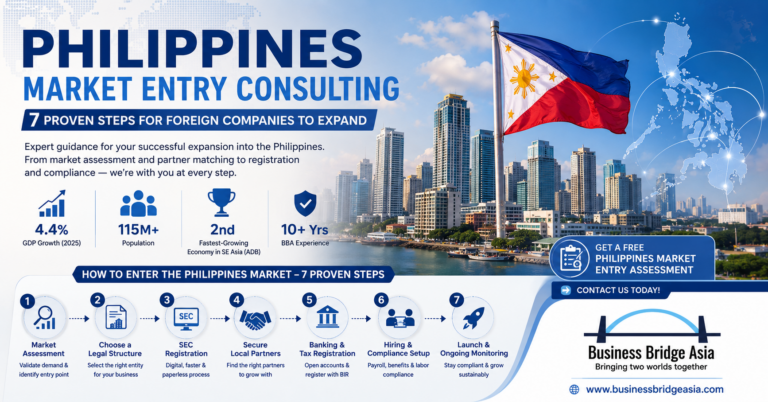
How do I enter the Philippines market as a foreign company?
Entering the Philippines market typically involves seven steps: (1) market assessment, (2) choosing a legal structure, (3) registering with the Securities and Exchange Commission, (4) securing local partners where needed, (5) opening local banking and tax registration, (6) hiring and compliance setup, and (7) launch and ongoing regulatory monitoring. The Philippines’ SEC has digitized much of this process through platforms like eSPARC and OneSEC, though local coordination still speeds things up considerably.
What do Philippines business consulting services typically cover?
Philippines business consulting services typically cover market research, entity registration support, local partner introductions, regulatory compliance guidance, and due diligence on prospective partners or suppliers. The scope varies by firm — some cover only initial setup, while others provide ongoing support once the business is operating.
When comparing providers, confirm whether their support ends at registration or continues through actual operations — the difference matters most once your business is live and dealing with day-to-day compliance and partner management.
When should a company use Philippines business expansion consulting?
Philippines business expansion consulting is typically most valuable after a company has validated initial demand and is deciding whether to scale operations, add a second location, or expand into new sectors within the country — rather than at first-entry stage, when market assessment services are more appropriate.
Companies that treat Philippines entry as a one-time project often underinvest in the expansion phase — scaling successfully usually requires the same local relationships used at entry, applied to a second wave of growth.
How do I find reliable local business partners in the Philippines?
Reliable Philippines partner matching typically comes through an advisory firm with an existing local network, since personal introductions and reputation carry significant weight in Philippine business culture. Due diligence on any prospective partner’s registration, financial standing, and reputation should be completed before signing an agreement.
Business Bridge Asia’s Philippines partner matching services connect foreign companies with vetted distributors and partners, reducing the months of independent searching most companies otherwise face when looking for local business partners Philippines-wide.
What should SMEs know about doing business in the Philippines? SMEs doing business in the Philippines benefit from a large domestic consumer market and young, English-speaking workforce, but should budget for the same registration and compliance steps larger companies face — the process has become more digital but not necessarily faster for a company without local support navigating it for the first time. |
Smaller companies often benefit from a phased approach — starting with a distribution partnership before committing to a full entity registration — to validate demand while keeping upfront costs manageable.
What is the best Philippines market entry strategy for US companies?
US companies typically benefit from a Philippines market entry strategy that leverages the shared English language and existing business ties between the two countries, while still budgeting time for SEC registration and local partner due diligence — advantages that reduce some friction but don’t eliminate the need for proper local coordination.
If you’re comparing providers for this stage, our guide on how to choose an Asia market entry consulting firm covers the same evaluation criteria that apply to Philippines-focused engagements.
What regulatory compliance issues should foreign companies expect in the Philippines?
Foreign companies should expect ongoing compliance obligations around foreign ownership limits by sector, tax registration with the Bureau of Internal Revenue, and labor law requirements — areas that continue evolving under the government’s Strategic Investment Priority Plan, making periodic compliance review worthwhile even after initial registration is complete.
Before finalizing any partnership as part of your Philippines expansion, our Asia Due Diligence Guide covers the same verification standard we recommend for any prospective partner, supplier, or distributor.
See our Real Results page for examples of how this kind of support has played out for other clients across the Asia-Pacific.
A: Costs vary by scope — market assessment alone costs less than a full engagement covering registration, partner matching, and compliance setup. A free consultation is the fastest way to get an accurate estimate for your specific plans.
A: With the SEC’s expanded digital registration systems, standard incorporation can move faster than in past years, though timelines still vary by entity type and sector. Companies working with local support typically move through the process more predictably than those navigating it independently.
A: It depends on your sector — some industries allow full foreign ownership, while others require local participation. Even where not required, a local partner often speeds up market access and partner introductions.
A: Yes, particularly given the shared English language and existing business ties — but US companies still need to budget time for SEC registration and local due diligence, the same as any other foreign entrant.
A: Yes — Philippines market entry consulting and partner due diligence are both part of Business Bridge Asia’s core services, so you don’t need to coordinate between separate providers for each.
A: Services, business process outsourcing, and digital-economy sectors continue to be strong growth areas, supported by the country’s young workforce and government initiatives to streamline business registration.
Whether you’re just evaluating the Philippines or ready to register and find a local partner, Business Bridge Asia can help — from market assessment to on-the-ground execution.
Get a Free Philippines Market Entry Assessment → businessbridgeasia.com/contacts/