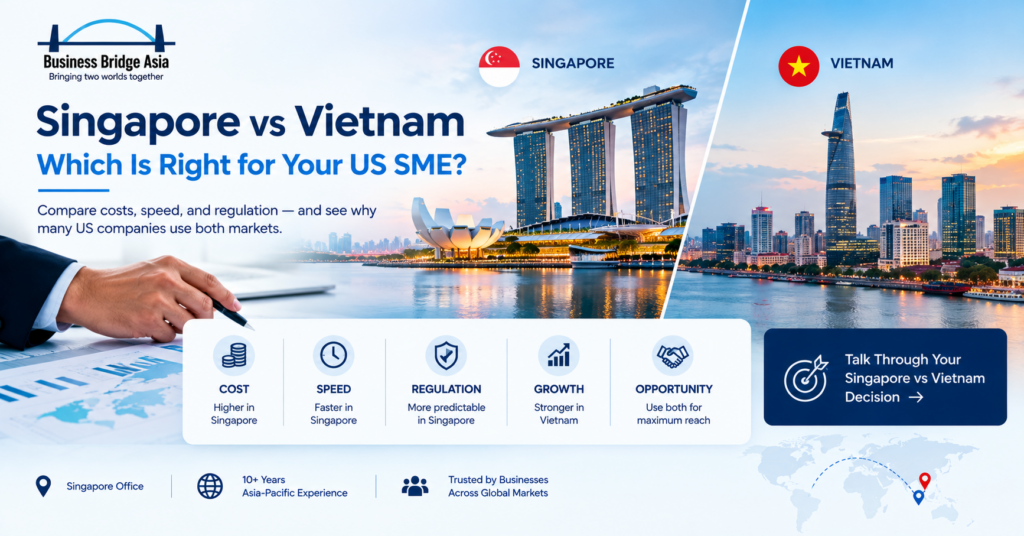
Singapore vs Vietnam Which Is Right for Your US SME?

By Business Bridge Asia Team | Southeast Asia Market Comparison

In short: Singapore wins on speed, predictability, and credibility — incorporation in days, 82 hours/year of tax admin, and a 2nd-place global ease-of-business ranking. Vietnam wins on cost and growth exposure — operating costs roughly a fifth of Singapore’s, and GDP growth targeted at 8.3-8.5% versus Singapore’s 4%. Many US SMEs don’t actually have to choose — a growing number use Singapore as a regional base and Vietnam for lower-cost operations.

Best suited for: US SMEs deciding between a first Southeast Asia entry point, or evaluating whether to combine both markets rather than pick one.

Should a US SME choose Singapore or Vietnam for Southeast Asia expansion?

It depends on the priority: Singapore suits companies prioritizing speed, regulatory predictability, and regional credibility, with incorporation possible within days and consistently ranked among the world’s easiest places to do business. Vietnam suits companies prioritizing cost efficiency and exposure to faster GDP growth, particularly for manufacturing or labor-intensive operations, though the incorporation process takes longer and involves more procedural steps.

The Head-to-Head Comparison

Factor🇸🇬 Singapore🇻🇳 Vietnam
Ease of doing businessRanked #2 globallyImproving, but more provincial variance
Incorporation speedDays18-40 working days (IRC + ERC)
Foreign ownership100% in most sectors100% permitted, more complex process
Corporate tax rate17%, no capital gains taxStandard rate, sector-based incentives
Tax admin burden~82 hours/year~872 hours/year
GDP growth (2026 target)~4%8.3-8.5%
Monthly operating cost (mfg.)Baseline (higher)Roughly 1/5 of Singapore’s
Best forHQ, banking, credibility, speedManufacturing, cost efficiency, growth


singapore vs vietnam for us smes

Why Many US SMEs Use Both, Not Either

Can a company use both Singapore and Vietnam instead of choosing one?

Yes — this is increasingly common. Companies often incorporate in Singapore for credibility, banking access, and its extensive treaty network, while running manufacturing or lower-cost operations in Vietnam. Singapore is already Vietnam’s top ASEAN investor, with cumulative registered capital around $66 billion, reflecting how established this dual approach has become.

This structure isn’t automatic, though – it requires attention to transfer pricing, permanent establishment exposure, and how the Singapore-Vietnam tax treaty applies to your specific setup. Getting this wrong doesn’t just cost money; it can trigger compliance issues in both jurisdictions at once.

The Cost Question, Honestly

Vietnam’s labor and operating costs are genuinely lower — manufacturing operating costs run roughly a fifth of Singapore’s equivalent, and monthly minimum wages are increasing 7.2% in 2026 but remain far below Singapore’s. But “cheaper” isn’t the same as “cheaper overall” once you factor in Vietnam’s longer incorporation timeline, higher tax administration burden (872 hours/year vs. Singapore’s 82), and the value of Singapore’s Singapore MRA Grant Guide — grant funding that can offset a meaningful share of market entry costs and isn’t available in the same form in Vietnam.

What About Tariffs and Trade Exposure?

How do trade agreements affect the Singapore vs Vietnam decision?

Vietnam participates in major trade agreements including CPTPP, RCEP, and the EU-Vietnam Free Trade Agreement, offering tariff advantages neighboring markets don’t fully match — though recent US tariff changes affecting Vietnamese exports have added new complexity for export-focused manufacturers specifically. Singapore’s extensive network of roughly 80 double taxation agreements offers a different kind of trade advantage, centered on financial and services flows rather than physical goods.

Verify Any Local Partner, Regardless of Which Market You Choose

Whichever market — or combination — you choose, don’t skip verifying local partners, suppliers, or service providers before committing. Our Asia Due Diligence Guide covers the verification process we recommend in both markets.

Real Results From Companies Choosing Between These Markets

Business Bridge Asia has supported companies structuring presence across both Singapore market entry and Vietnam market entry, including a case where a distribution partner’s international sales doubled within a year of proper structuring. Read the full real, sourced case studies.

Frequently Asked Questions — Singapore vs Vietnam

No schema found.

Talk Through Your Singapore vs Vietnam Decision

Whether you’re choosing one market or considering both, we can walk through what actually fits your specific business.

Talk Through Your Singapore vs Vietnam Decision