By Business Bridge Asia Team | Asia-Pacific Market Entry Consulting
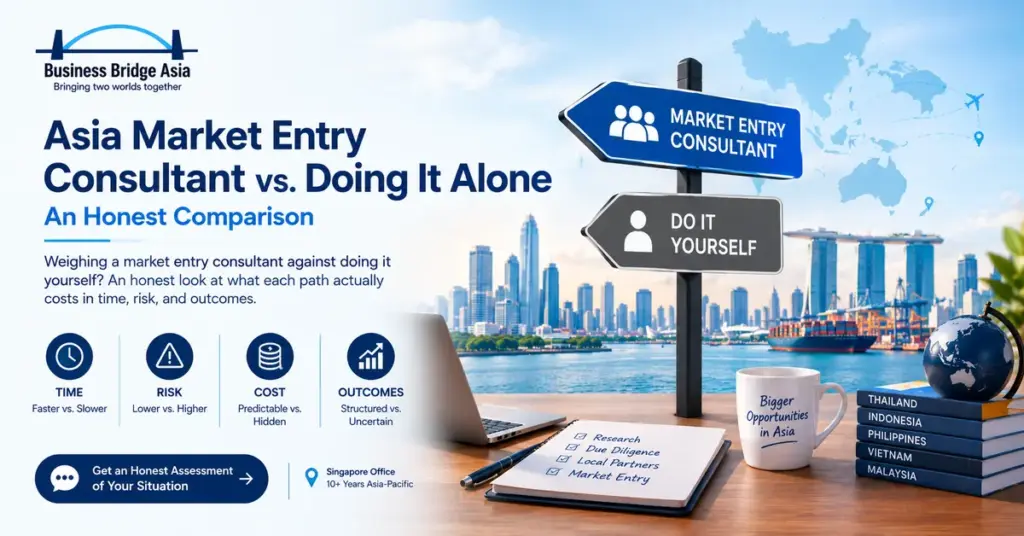
In short: Doing it alone can genuinely work — for some companies, in some markets. It usually doesn’t for first-time entrants without existing local relationships. This is an honest look at when each path actually makes sense, not an argument that you always need a consultant.
Should I hire a market entry consultant or handle Asia expansion myself?
It depends primarily on whether you already have local relationships and market knowledge. Companies with existing in-market contacts, prior regional experience, or a team member who has done this before can often handle entry independently. Companies without any of these usually find that a consultant’s existing local network saves more in time and avoided mistakes than the fee costs.
To be fair to the DIY path — it’s not always the wrong call. It tends to work when:
▸ You already have local relationships — an existing distributor, partner, or team member with real in-market experience.
▸ You’ve done this before — in this specific country, not just “internationally” in general.
▸ You have time to absorb a slower timeline — independent research and relationship-building takes longer than most companies initially budget for.
Where It Usually Breaks Down
“We’ll figure out partners once we’re there.”
This is the single most common reason independent entries stall. Vetted local partners rarely respond quickly to cold outreach from an unfamiliar foreign company — a warm introduction through an existing network typically moves in weeks, not months.
“We can do due diligence ourselves — it’s just paperwork.”
Verifying a partner’s registration, financials, and reputation from abroad is genuinely difficult without local access to the right registries and contacts. This is also the step most commonly skipped under time pressure — and the one most likely to cause a costly mistake later.
“The regulations can’t be that different from home.”
They usually are — sometimes significantly. Foreign ownership caps, licensing requirements, and compliance obligations vary by country and by sector, and getting this wrong at entry is far more expensive to fix later than to get right upfront.
The Real Cost Comparison
Is it actually cheaper to enter an Asian market without a consultant?
Not usually, once you account for the full cost — including the time spent on independent research, the higher likelihood of partnership mistakes without local vetting, and the slower timeline to first revenue. Consulting fees are visible and upfront; the cost of an independent approach going wrong tends to be larger but less visible until it happens.
Our Cost to Enter the Asian Market guide breaks down real consulting costs by country and service — worth reviewing alongside your own estimate of what independent research and relationship-building would cost in time.
Not every firm is worth the fee. Our guide on how to choose an Asia market entry consulting firm covers what actually separates a useful engagement from an expensive strategy deck. And whichever path you take, don’t skip due diligence — our Asia Due Diligence Guide covers the verification process that matters most, regardless of who’s leading the process.
Real Results From Companies Who Chose Support
A US freight forwarding company secured 100% foreign ownership in the Philippines and Indonesia after a previous independent attempt couldn’t achieve that structure. A Thailand-based energy technology company avoided a fraudulent $9 million investment offer entirely because local due diligence caught it within 48 hours — something their US-based legal team couldn’t do remotely. Read the full real, sourced case studies.
Frequently Asked Questions
No schema found.
Get an Honest Assessment of Your Situation
Not sure which path fits your situation? We’ll give you a straight answer, even if that answer is that you’re well-positioned to handle it yourself.