How to Enter the Malaysian Market: A Complete Guide for Foreign Companies

Malaysia is one of Southeast Asia’s most business-friendly and strategically well-connected markets. For foreign companies seriously considering how to enter the Malaysian market, the combination of advantages is compelling: a multilingual, educated workforce fluent in English and Mandarin, world-class infrastructure centred on Kuala Lumpur, one of ASEAN’s most diversified economies, and a government that has actively courted foreign investment for decades.

Yet doing business in Malaysia as a foreign company requires genuine preparation — understanding the country’s multicultural business environment (Malay, Chinese-Malaysian, and Indian-Malaysian communities each operate with distinct norms), navigating equity ownership rules in certain sectors, and building the right local relationships on the ground. This guide gives you the practical, honest roadmap.

How do you enter the Malaysian market as a foreign company?
To enter the Malaysian market as a foreign company: (1) define your objective — manufacturing, distribution, technology, or services; (2) conduct Malaysia market research to validate local demand; (3) understand the regulatory environment — SSM company registration, MIDA incentive eligibility, sector-specific licensing; (4) identify and vet local business partners in Malaysia; (5) register a Sdn Bhd (private limited company) through SSM — typically completed in 1–3 business days; and (6) execute with on-the-ground support from Kuala Lumpur. Business Bridge Asia provides Malaysia market entry consulting for foreign SMEs across all six stages.
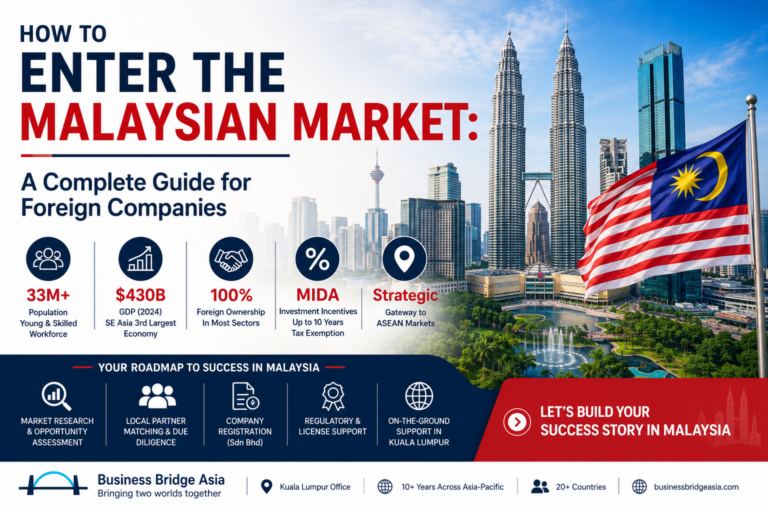
Business Bridge Asia has a Kuala Lumpur-based team with established relationships across Malaysia’s corporate, government, and investment community — across all three of Malaysia’s major business communities and across key sectors including manufacturing, technology, consumer goods, and professional services. We have supported SMEs from the US, Singapore, Europe, and Australia through every stage of Malaysia market entry.

33M+

Population
Highly educated

$430B

GDP (2024)
SE Asia 3rd largest

4.4%

GDP Growth
Stable annual

Top 12

Ease of Business
World Bank
How to Enter the Malaysian Market

Why Malaysia? The Business Case for Foreign Companies

Why should foreign companies enter the Malaysian market?
Foreign companies should enter Malaysia because it offers: a multilingual workforce fluent in English, Malay, Mandarin, and Tamil; world-class infrastructure in Kuala Lumpur and Penang; one of Southeast Asia’s most diversified economies across manufacturing, technology, Islamic finance, and services; strong MIDA investment incentives including Pioneer Status (up to 10 years tax exemption) for qualifying investments; 100% foreign ownership permitted in most sectors; and a strategically central ASEAN location connecting Thailand, Singapore, Indonesia, and the Philippines.

Multilingual, Educated Workforce

Malaysia’s workforce is one of Southeast Asia’s most internationally capable. English is widely used in business, government, and legal contexts. Mandarin is spoken natively by approximately 23% of the population, making Malaysia the only ASEAN country (outside Singapore) where Mandarin-language business relationships are mainstream. This multilingual capability is a practical operational advantage for companies managing activities across multiple Asian markets.

Strategic Central ASEAN Location

Malaysia sits at the geographic heart of Southeast Asia — sharing borders with Thailand in the north, connected by causeway to Singapore in the south, and within easy reach of Indonesia, Brunei, Vietnam, and the Philippines. For companies building a regional Southeast Asia strategy, Malaysia’s centrality and connectivity offer logistics and operational advantages that few other ASEAN locations match.

MIDA Investment Incentives

Malaysia’s Investment Development Authority (MIDA) offers meaningful incentives for qualifying foreign investments — including Pioneer Status (full corporate tax exemption for 5–10 years), Investment Tax Allowance, and specific packages for high-technology, green economy, and digital economy investments. MIDA’s application process is well-structured and accessible for SMEs meeting the qualifying criteria.

100% Foreign Ownership in Most Sectors

Malaysia permits 100% foreign ownership of a Sdn Bhd (private limited company) in the majority of business sectors, including manufacturing, technology, professional services, and most consumer goods. This makes Malaysia straightforwardly accessible for foreign companies that want full control of their Malaysian operation without mandatory local equity partners.

Malaysia as Part of Your Southeast Asia Expansion Strategy

How does Malaysia fit into a multi-country Southeast Asia expansion strategy?
Malaysia fits into a Southeast Asia expansion strategy as both a significant market in its own right (33 million consumers, GDP $430 billion) and a regional operational hub. Its central ASEAN location, English-language business environment, strong Chinese-Malaysian networks connecting to broader ASEAN, and proximity to Singapore, Indonesia, Thailand, and Vietnam make it a natural regional coordination base. Companies pursuing Malaysia Southeast Asia expansion consulting typically find Malaysia works best as either a standalone second ASEAN market after Singapore, or as a regional hub for multi-country strategies.

For companies pursuing Malaysia Southeast Asia expansion consulting — either entering Malaysia as part of a multi-country ASEAN strategy or using Malaysia as the base from which to manage wider Southeast Asian operations — Business Bridge Asia provides integrated market entry support covering both the Malaysia-specific requirements and the broader regional context.

Malaysia’s Chinese-Malaysian business community — well-networked across Southeast Asia and with established connections to mainland China, Hong Kong, and Taiwan — provides a particularly valuable commercial bridge for foreign companies entering the broader ASEAN market. The right Malaysian partner often brings regional relationships that extend significantly beyond Malaysia’s own borders.

Malaysia Market Entry Strategy for SMEs — Step by Step

What is the best Malaysia market entry strategy for SMEs?
The best Malaysia market entry strategy for SMEs follows six steps: (1) Define objective — manufacturing, distribution, services, or regional hub. (2) Conduct Malaysia market research — validate demand across Malaysia’s multicultural market segments. (3) Navigate the regulatory environment — SSM registration, MIDA incentive application, sector-specific licensing. (4) Find local business partners in Malaysia suited to your sector and target community. (5) Register your Sdn Bhd through SSM MyCoID portal — typically 1–3 business days. (6) Execute with Kuala Lumpur-based support during the launch phase.

1. Define Your Objective

A sound Malaysia market entry strategy for SMEs starts with defining exactly what you are trying to achieve. Are you manufacturing electronics or industrial products in Penang or the Klang Valley industrial corridors? Distributing consumer products to Malaysia’s growing middle class? Establishing a technology or financial services operation in Kuala Lumpur? Or using Malaysia as the regional hub for your Southeast Asia strategy? Each objective requires a different legal structure, location within Malaysia, MIDA eligibility assessment, and partner type.

2. Conduct Malaysia Market Research

Validating your assumptions with on-the-ground Malaysia market research before committing resources is the highest-return early investment in any Malaysia market entry. Malaysia is a genuinely multicultural market — consumer behaviour, purchasing power, and business culture differ meaningfully across the Malay, Chinese-Malaysian, and Indian-Malaysian communities, and across different geographic regions from Kuala Lumpur and Penang to Johor Bahru and East Malaysia (Sabah and Sarawak).

3. Understand the Regulatory Environment

Company registration in Malaysia is handled through SSM (the Companies Commission) via the MyCoID online portal. A Sdn Bhd is the standard legal entity for foreign-owned companies in Malaysia — minimum paid-up capital of MYR 1, and requires at least one Malaysia-resident director. For MIDA incentive applications, the process involves a separate application to MIDA with investment proposal documentation. Sector-specific business licensing applies in regulated industries including healthcare, education, financial services, and food production.

4. Finding Local Business Partners in Malaysia

How do you find reliable local business partners in Malaysia?
To find reliable local business partners in Malaysia: work with a specialist Malaysia market entry consulting firm with established in-country networks across all three business communities; engage with the Malaysian Chinese Chamber of Commerce and Industry (MCCCI), Malay Chamber of Commerce (DPMM), or AmCham Malaysia; and always conduct thorough due diligence — including financial background checks, regulatory standing, community reputation, and direct reference calls — before committing. Business Bridge Asia’s Malaysia partner matching service has verified relationships across Kuala Lumpur, Penang, Johor Bahru, and East Malaysia.

Finding the right local business partners in Malaysia is one of the most consequential decisions in your Malaysia market entry. Malaysia’s business landscape is shaped by three distinct communities — each with different networks, industry strengths, and relationship norms. Understanding which community your partner should come from for your specific sector is as important as the partner’s credentials and financial standing.

Business Bridge Asia’s Malaysia partner matching consulting service identifies, screens, and introduces you to partners whose community networks, industry relationships, and track records we have personally verified — across Kuala Lumpur, Penang, Johor Bahru, and other key business centres.

5. Register Your Sdn Bhd

SSM company registration through MyCoID is typically completed within 1–3 business days. Requirements include at least one Malaysia-resident director (a professional nominee director service can fulfil this requirement for 100% foreign-owned companies), a Malaysia registered address, and minimum paid-up capital of MYR 1. Once registered, the Sdn Bhd can open Malaysian bank accounts, apply for business licenses, and begin commercial activity.

6. Execute With On-the-Ground Support

Malaysia’s multicultural business environment — with its distinct Malay, Chinese-Malaysian, and Indian-Malaysian commercial communities, each requiring a somewhat different relationship approach — makes genuine local presence essential during the market launch phase. A Kuala Lumpur-based team or consulting partner who understands which community networks matter for your sector, and how to navigate the informal relationship dynamics, significantly increases your probability of a successful Malaysia entry.

Malaysia Market Research Services — Validating Your Opportunity

What does Malaysia market research involve for foreign companies?
Malaysia market research for foreign companies covers: demand analysis across Malaysia’s three major consumer communities (Malay, Chinese-Malaysian, Indian-Malaysian); competitive landscape mapping for both local Malaysian players and existing foreign competitors; pricing benchmark analysis across online and offline channels; distribution channel assessment including retail, wholesale, e-commerce (Malaysia’s e-commerce adoption is among Southeast Asia’s highest), and B2B pathways; and regulatory environment mapping for your specific sector. Business Bridge Asia’s Malaysia market research services are conducted on the ground in Kuala Lumpur and key regional cities.

Our Malaysia market research services are conducted on the ground in Malaysia — not from a desk outside the country. This matters because Malaysia’s multicultural market dynamics, informal business networks, and regional variations (between Kuala Lumpur, Penang, Johor Bahru, and East Malaysia) are difficult to assess accurately through secondary research alone.

Key areas our Malaysia market research covers: consumer demand validation across Malaysia’s multicultural market segments; e-commerce landscape assessment; regulatory environment mapping for your sector; distribution channel options; and MIDA incentive eligibility assessment for your investment profile.

Malaysia Business Expansion Consulting — How Business Bridge Asia Helps

What Malaysia market entry consulting services does Business Bridge Asia provide?
Business Bridge Asia’s Malaysia market entry consulting services include: Malaysia market entry strategy development; Malaysia market research and demand assessment; local partner identification, screening, and introduction; Malaysia partner matching consulting; due diligence on Malaysian business partners; Sdn Bhd company registration support; MIDA incentive application guidance; Bahasa Malaysia translation and cross-cultural advisory across all three Malaysian business communities; and ongoing Malaysia business expansion consulting from our Kuala Lumpur-based team.

Our Malaysia business expansion consulting practice covers the full market entry journey — from initial demand validation through to partner onboarding, legal setup, and operational launch. We have local teams in Kuala Lumpur with relationships across all three of Malaysia’s major business communities, across government bodies including MIDA and SSM, and across key sectors.

▸ Malaysia Market Entry Consulting

We develop your Malaysia market entry strategy — market assessment, entry mode selection, partner requirements, regulatory roadmap, and investment timeline.

▸ Malaysia Market Research

On-the-ground demand validation, competitor mapping, pricing analysis, and distribution channel assessment across Malaysia’s multicultural market segments.

▸ Malaysia Partner Matching

We identify, screen, and introduce you to local partners whose community networks, industry relationships, and track records we have personally verified.
Background checks on potential Malaysian business partners — financial standing, regulatory compliance, community reputation, and direct reference verification.
Professional Bahasa Malaysia translation and cultural advisory — covering Malaysia’s multicultural business environment across Malay, Chinese-Malaysian, and Indian-Malaysian community contexts.

Further Reading — Southeast Asia Market Entry Guides

If Malaysia is part of a broader Southeast Asia expansion strategy, these country-specific guides cover neighbouring markets:

The strategic overview for SMEs considering multi-country Southeast Asia expansion.
Malaysia and Indonesia are frequently entered together — our Indonesia guide covers PT PMA registration, partner matching, and regulatory navigation.
Thailand is the third pillar of most mainland Southeast Asia strategies alongside Malaysia and Indonesia.
Vietnam’s manufacturing competitiveness makes it a natural companion to Malaysia for companies with both production and distribution objectives.
Full pricing breakdown for Malaysia market entry services — strategy, partner matching, due diligence, and registration support.

Frequently Asked Questions — Malaysia Market Entry

Q: Can a foreign company own 100% of a Malaysian Sdn Bhd?

A: Yes, in most sectors. Malaysia allows 100% foreign ownership of a Sdn Bhd in the majority of business activities — including manufacturing, technology, professional services, and most consumer goods sectors. Equity conditions requiring Malaysian co-ownership apply in certain regulated sectors including media, broadcasting, education, and some retail categories. MIDA can advise on sector-specific equity requirements as part of the investment approval process.

Q: How long does it take to register a company in Malaysia?

A: SSM registration of a Sdn Bhd through MyCoID is typically completed in 1–3 business days. Additional steps — MIDA incentive applications, sector-specific business licensing, and tax registration — can extend the overall timeline to 4–8 weeks depending on your business activity and whether MIDA incentives are being pursued.

Q: Can a 100% foreign-owned company qualify for the MRA grant?

A: Not legally, in most sectors. Malaysia permits 100% foreign-owned Sdn Bhds in the majority of business activities. However, having the right local partner — even where not legally required — is strongly recommended for market access, government relationships, and operational effectiveness. The question is not whether you legally need a partner, but whether the right partner would significantly accelerate your success.

Q: What is the Bumiputera equity requirement?

A: The Bumiputera equity requirement — mandating minimum ownership by indigenous Malay and other indigenous groups — applies in certain specific sectors in Malaysia, including some retail categories, construction, and government procurement contexts. For most manufacturing and services sectors relevant to foreign SMEs, no Bumiputera equity requirement applies. Business Bridge Asia can advise on whether your specific business activity is affected.

Q: Is English sufficient for doing business in Malaysia?

A: Yes, in most business contexts in Kuala Lumpur and Penang. English is widely used across corporate, legal, financial, and government contexts. Bahasa Malaysia proficiency — or professional translation — becomes important for consumer-facing marketing, government tender documentation, and building relationships in Malay-majority business environments. Business Bridge Asia’s cross-cultural advisory service covers Malaysia’s multilingual business dynamics in practical detail.

Q: What makes Malaysia different from other Southeast Asian markets?

A: Malaysia’s key differentiators are: its trilingual business environment (English, Malay, Mandarin); 100% foreign ownership in most sectors without mandatory local partners; world-class Kuala Lumpur infrastructure comparable to Singapore at significantly lower cost; the Chinese-Malaysian business community’s regional ASEAN networks; and MIDA’s proactive, accessible incentive programme for qualifying foreign investments.

Ready to Enter the Malaysian Market?

Malaysia is one of Southeast Asia’s most accessible, well-connected, and strategically important markets. With the right local partners and on-the-ground expertise, it is also one of the most rewarding for foreign SMEs. Business Bridge Asia gives you the Kuala Lumpur-based team, the verified partner network, and the practical guidance to enter Malaysia successfully — from your first market research call through to operational launch.