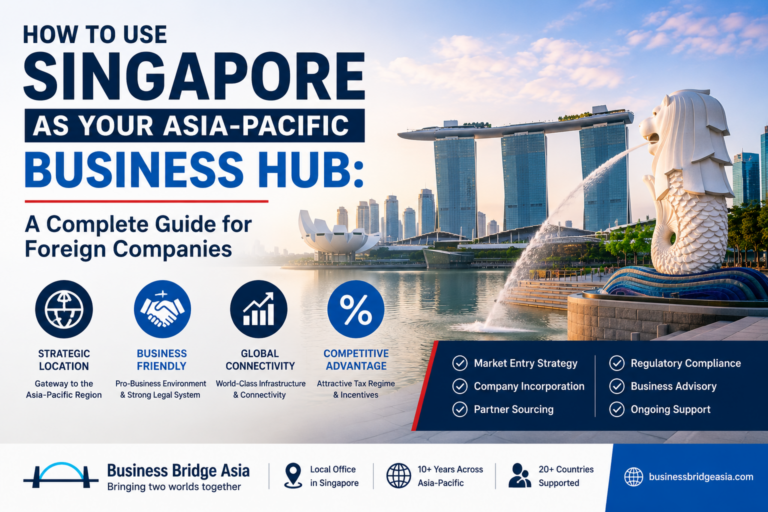
How to Use Singapore as Your Asia-Pacific Business Hub: A Complete Guide for Foreign Companies

Singapore is Asia-Pacific’s premier business hub — and for very good reasons. As a foreign company considering how to establish a base in Asia, using Singapore as your Asia-Pacific business hub offers a combination of advantages that no other city in the region can match: a world-class regulatory environment, English as the primary business language, a network of Free Trade Agreements covering 26 countries, one of the world’s most competitive tax regimes, and a government that actively supports business growth with a range of grants and incentive programmes.

This guide explains how Singapore company expansion consulting works in practice — from incorporating your Singapore entity and qualifying for government grants through to using Singapore as the operational gateway for your broader Asia-Pacific expansion.

How do you use Singapore as an Asia-Pacific business hub?
To use Singapore as your Asia-Pacific business hub, foreign companies should: (1) incorporate a Singapore Private Limited Company (Pte Ltd) — typically completed in 1–2 days; (2) apply for relevant EntrePass, Employment Pass, or Personalised Employment Pass for key staff; (3) leverage Singapore’s network of Free Trade Agreements covering 26 countries for preferential market access; (4) apply for applicable government grants — including the Market Readiness Assistance (MRA) grant for SMEs expanding overseas; and (5) establish a Singapore-based team or appoint a Singapore company expansion consulting firm to manage regional operations. Business Bridge Asia provides Singapore business consulting services for foreign companies setting up their Asia-Pacific hub.
Business Bridge Asia has a Singapore-based team with established networks across government agencies, business development bodies, and the Singapore corporate community. We have supported companies from the United States, Europe, and Australia in establishing their Singapore hub and using it to access markets across Southeast Asia, South Asia, and the broader Asia-Pacific region.

1–2 days

Business Setup
Fastest in Asia

26+

FTAs
Countries covered

17%

Corp Tax
Effective rate often lower

Top 2

Ease of Business
World Bank ranking
Singapore BBA

Why Singapore? The Case for Using Singapore as Your Asia-Pacific Hub

Why is Singapore the best Asia-Pacific business hub for foreign companies?
Singapore is the best Asia-Pacific business hub for foreign companies because it offers: the world’s easiest company registration process (1–2 days); English as the primary business and legal language; 26+ Free Trade Agreements giving preferential access to major markets; a 17% corporate tax rate with extensive exemptions for new companies; zero capital gains tax and no dividend withholding tax; a highly developed financial system; and a government that actively supports businesses through grants including the Market Readiness Assistance (MRA) grant for SMEs expanding overseas.

World's Easiest Business Registration

Singapore consistently ranks among the world’s top two countries for ease of doing business. A Singapore Private Limited Company (Pte Ltd) can be incorporated online in 1–2 business days through ACRA (Accounting and Corporate Regulatory Authority). Minimum paid-up capital is just SGD 1. This speed and simplicity makes Singapore the natural starting point for any Asia-Pacific market entry strategy.

English Business Environment

Singapore’s legal system, regulatory documentation, business contracts, and corporate communication are all conducted in English — removing the translation and cultural complexity that adds cost and risk in every other major Asian market. For US, UK, and Australian companies in particular, this makes Singapore the natural first base in Asia.

Network of Free Trade Agreements

Singapore’s 26+ Free Trade Agreements — including CSFTA, USSFTA (with the United States), EUSFTA, and RCEP — give Singapore-based companies preferential tariff rates and market access across much of the world. For companies manufacturing or sourcing in the region and exporting globally, Singapore’s FTA network is a genuine competitive advantage.

Tax Efficiency

Singapore’s headline corporate tax rate of 17% is one of the lowest in Asia, and new companies benefit from significant tax exemptions in their first three years — effectively reducing the tax rate to single digits on the first SGD 200,000 of chargeable income. Zero capital gains tax and no withholding tax on dividends add to Singapore’s tax efficiency profile.

Government Grants and Support

Singapore’s government actively supports business growth through Enterprise Singapore — a government agency that administers a range of grants for SMEs. The most relevant for foreign companies using Singapore as their Asia-Pacific hub is the Market Readiness Assistance (MRA) grant — which provides funding support for SMEs expanding overseas, covering market entry consultancy costs, overseas market setup, and business development activities.

Singapore MRA Grant — What It Is and How Foreign Companies Can Use It

What is the Singapore MRA grant and how can US companies use it?
The Singapore Market Readiness Assistance (MRA) grant is an Enterprise Singapore grant that funds up to 50% of qualifying costs (capped at SGD 100,000 per new market) for Singapore-registered SMEs expanding overseas. Qualifying costs include market entry consultancy fees, overseas business development, and market setup expenses. US companies that incorporate a Singapore Pte Ltd and meet the SME eligibility criteria (annual turnover below SGD 100 million or fewer than 200 employees) can apply for MRA grant support for market entry consulting fees — including Business Bridge Asia’s Singapore MRA grant consulting services.

For foreign companies incorporating in Singapore, the Singapore MRA grant represents a significant financial advantage that many companies overlook. If your Singapore entity qualifies as an SME under Enterprise Singapore’s criteria — annual turnover below SGD 100 million or fewer than 200 employees — you can apply for MRA grant support that covers up to 50% of your qualifying overseas expansion costs.

What MRA Grant Covers

  • Market entry consultancy fees — including fees paid to consulting firms like Business Bridge Asia for market entry strategy, partner matching, and due diligence
  • Overseas market setup costs — legal entity registration, regulatory filings, licensing fees in your target market
  • Business development activities — trade missions, market research, overseas sales trips

MRA Grant for US Market Entry Support

One specific application of the MRA grant that is particularly relevant for US-headquartered companies with a Singapore entity is Singapore MRA grant US market entry support. If your Singapore Pte Ltd is expanding into the United States — or using Singapore as the hub through which US market entry activities are managed — qualifying consultancy and market development costs may be eligible for MRA funding. Business Bridge Asia can advise on MRA eligibility as part of your Singapore company expansion consulting engagement.

The MRA grant application process requires careful documentation of qualifying expenditure and a formal application to Enterprise Singapore. Business Bridge Asia’s Singapore MRA grant consulting service covers grant eligibility assessment, application preparation, and claims documentation support.

Singapore Market Entry Strategy for Foreign Companies — Step by Step

What is the Singapore market entry strategy for foreign companies?
A Singapore market entry strategy for foreign companies typically involves five steps: (1) Incorporate a Singapore Pte Ltd through ACRA — completed in 1–2 business days. (2) Apply for the relevant work pass (Employment Pass, EntrePass, or Personalised Employment Pass) for key personnel. (3) Assess MRA grant eligibility and apply to Enterprise Singapore for market readiness funding. (4) Establish a local Singapore team or appoint a Singapore business consulting firm to manage operations. (5) Use Singapore as the operational hub for market entry into Vietnam, Indonesia, Thailand, Philippines, and other target ASEAN markets.

1. Incorporate Your Singapore Pte Ltd

Company registration in Singapore through ACRA’s BizFile+ portal is one of the fastest and simplest in the world — typically completed in 1–2 business days. Requirements are minimal: at least one director who is a Singapore resident or Employment Pass holder, a Singapore registered address, and a minimum paid-up capital of SGD 1. Once incorporated, you have a Singapore legal entity through which all regional operations can be structured.

2. Secure Employment Passes for Key Personnel

Singapore’s Employment Pass (EP) is available for foreign professionals earning above SGD 5,000 per month (higher thresholds apply for financial services). The EntrePass is available for foreign entrepreneurs starting businesses in Singapore. The Personalised Employment Pass (PEP) provides greater flexibility for high-earning professionals. MOM (Ministry of Manpower) processing times are typically 3–8 weeks.

3. Apply for MRA Grant

Once your Singapore entity is incorporated and active, assess your MRA grant eligibility with Enterprise Singapore. The grant covers up to 50% of qualifying overseas market entry costs, capped at SGD 100,000 per new overseas market. Applications must be submitted before incurring the qualifying expenditure — so early planning is essential. Business Bridge Asia’s Singapore MRA grant consulting service covers the full application process.

4. Establish Singapore Operations

Even a lean Singapore setup — a small office, a Singapore-based business development manager, and local banking relationships — provides the operational foundation from which to run your Asia-Pacific activities. Singapore’s professional services ecosystem (accounting, legal, HR) is world-class and makes it straightforward to establish compliant, functional regional operations quickly.

5. Use Singapore as Your ASEAN Gateway

With your Singapore hub established, use it as the operational base for entering your target ASEAN markets — Vietnam, Indonesia, Thailand, the Philippines, Malaysia, and beyond. Singapore’s geographic location, regional networks, and FTA framework make it the natural coordination point for multi-country Asia-Pacific strategies.

Singapore Partner Matching — Building the Right Regional Network

How do you find business partners in Singapore for Asia-Pacific expansion?
To find business partners in Singapore for Asia-Pacific expansion, foreign companies should: engage a Singapore business consulting firm with established regional networks; leverage Singapore’s business chambers (AmCham Singapore, British Chamber, AustCham) and sector-specific associations; work with Enterprise Singapore to identify potential Singapore partners; and conduct thorough due diligence on any potential partner before committing. Singapore’s partner ecosystem is mature and well-networked — the right Singapore partner can open doors across the entire ASEAN region.

Business Bridge Asia’s Singapore partner matching services are built on years of established relationships across Singapore’s corporate, government, and investment community. We help foreign companies identify the right Singapore-based partners — whether that means a local distribution partner, a joint venture co-investor, a technology integration partner, or a Singapore company that can serve as your regional operating arm.

Finding the right Singapore partner is different from finding partners in other Asian markets — Singapore’s business community is sophisticated, well-connected, and internationally minded. The challenge is not convincing potential partners that you are a credible company (Singapore partners are experienced in working with foreign businesses) but rather finding the partner whose specific network, industry relationships, and geographic reach best fit your Asia-Pacific objectives.

Singapore Business Consulting Services — How Business Bridge Asia Helps

What Singapore business consulting services does Business Bridge Asia offer?
Business Bridge Asia’s Singapore business consulting services include: Singapore company incorporation support; Singapore MRA grant consulting and application management; Singapore market entry strategy for foreign companies; Singapore partner matching and network introductions; Singapore market research; due diligence on Singapore partners and investment opportunities; and ongoing Singapore company expansion consulting for companies using Singapore as their Asia-Pacific hub.

Our Singapore Asia Pacific hub consulting practice is specifically designed for foreign companies at the critical stage of establishing their Singapore foothold — and then using that foothold to access the broader Asia-Pacific opportunity. We have supported US, European, and Australian companies through this exact journey, and we understand both the Singapore-specific requirements and the regional market dynamics that determine success.

▸ Singapore Company Incorporation

We manage the ACRA registration process, director appointment, registered address provision, and initial compliance setup — getting your Singapore entity live in 1–2 business days.
We assess your eligibility, prepare your application, and support your claims documentation throughout the grant period. Business Bridge Asia’s consulting fees are eligible as qualifying MRA expenditure.
We build your Singapore and ASEAN market entry strategy — country prioritisation, entry mode, partner requirements, timeline, and budget.
We introduce you to Singapore-based partners — distributors, co-investors, operating partners, or regional representatives — whose credentials and networks we have personally verified.
Background checks on Singapore companies, directors, and investment opportunities — financial standing, regulatory history, market reputation, and reference verification.
While Singapore operates in English, expanding from Singapore into other ASEAN markets requires professional translation and cultural advisory across Vietnamese, Thai, Bahasa Indonesia, Tagalog, and other languages.

Further Reading — Asia-Pacific Market Entry from Your Singapore Hub

Once your Singapore hub is established, these country-specific guides will support your expansion across ASEAN:

Singapore to Indonesia is one of the most common Asia-Pacific expansion paths — our complete Indonesia market entry guide covers PT PMA registration, local partner matching, and regulatory compliance.
Vietnam is frequently the first manufacturing or sales destination for Singapore-based companies expanding into mainland Southeast Asia.
Thailand’s BOI system and US Treaty of Amity make it a natural second market for Singapore-hubbed companies with US or Western ownership.
Bangladesh’s manufacturing competitiveness makes it an important sourcing destination for Singapore-based consumer goods and retail companies.
Full pricing breakdown for all Asia market entry services — from Singapore incorporation through to on-the-ground support across ASEAN.

Frequently Asked Questions — Singapore as Your Asia-Pacific Hub

Q: How long does it take to incorporate a company in Singapore?

A: Singapore company incorporation through ACRA’s BizFile+ portal typically takes 1–2 business days. The process requires at least one Singapore-resident director, a local registered address, and minimum paid-up capital of SGD 1. Working with a Singapore incorporation service or consulting firm can streamline the process further, ensuring all documentation is correctly prepared on the first submission.

Q: Who qualifies for the Singapore MRA grant?

A: The Singapore Market Readiness Assistance (MRA) grant is available to Singapore-registered companies that meet Enterprise Singapore’s SME definition — annual turnover not exceeding SGD 100 million or fewer than 200 employees. The company must be incorporated in Singapore, have a minimum 30% local shareholding, and be expanding into a new overseas market. Qualifying expenditure includes market entry consultancy fees, overseas market setup costs, and business development activities.

Q: Can a 100% foreign-owned company qualify for the MRA grant?

A: No. The MRA grant requires a minimum 30% Singapore shareholding. Companies that are 100% foreign-owned do not qualify. However, companies that structure their Singapore Pte Ltd with a Singapore-resident co-founder, director holding shares, or Singapore corporate shareholder meeting the 30% threshold can qualify. Business Bridge Asia can advise on structuring options as part of our Singapore MRA grant consulting service.

Q: What is the difference between using Singapore as a hub versus incorporating directly in each ASEAN country?

A: Using Singapore as a hub provides: a stable English-language legal and regulatory environment for your holding or regional management company; access to Singapore’s FTA network; MRA grant support for market entry costs; and a sophisticated professional services ecosystem. Direct incorporation in each ASEAN country is still typically required for commercial operations in that specific market. The Singapore hub model manages regional strategy and coordination while market-specific entities handle local commercial activity.

Q: Does Business Bridge Asia's fee qualify as MRA grant expenditure?

A: Yes. Market entry consultancy fees paid to qualifying consulting firms — including Business Bridge Asia — are eligible as qualifying MRA expenditure, subject to Enterprise Singapore’s guidelines and grant approval. We can provide the necessary documentation to support your MRA grant application and claims process as part of our Singapore MRA grant consulting engagement.

Ready to Set Up Your Singapore Asia-Pacific Hub?

Singapore is the smartest starting point for any serious Asia-Pacific expansion strategy — and with the MRA grant potentially covering up to 50% of your market entry consulting costs, the financial case for starting here has never been stronger. Business Bridge Asia will handle everything from Singapore incorporation through to your first market entries across ASEAN.