
Companies searching for market entry advisory Southeast Asia can rely on long-term often assume it’s the same as one-time market entry consulting — it isn’t.
In short: Southeast Asia business advisory is ongoing support that continues after a company has entered a market — partner management, due diligence on new deals, compliance monitoring, and translation — across Vietnam, Thailand, Singapore, Indonesia, and other markets in the region.
Best suited for: companies already operating in one or more Southeast Asia markets, or planning to expand across several at once, who need continuity rather than a series of one-off engagements per country. If you haven’t entered a market yet, start with our Asia-Pacific market entry consulting page instead.
What is Southeast Asia business advisory?
Southeast Asia business advisory refers to ongoing professional support that continues after a company enters a market — including local partner management, due diligence on new deals, regulatory and compliance monitoring, and translation support. Unlike market entry consulting, which is a defined, time-bound project, business advisory typically continues for as long as a company operates in the region.
What’s the difference between market entry consulting and business advisory in Southeast Asia?
Market entry consulting is a defined project — market assessment, entity registration, and first partner introductions. Business advisory is ongoing — ongoing partner management, due diligence on new deals, compliance monitoring, and translation support that continues for as long as a company operates in the region. Many companies need both, in sequence: entry first, then advisory as operations mature.
If you’re still deciding whether and how to enter a Southeast Asia market, our Asia-Pacific market entry consulting page covers that process. This guide is for companies already past that stage — operating in the region and needing continuity rather than one more one-off project.
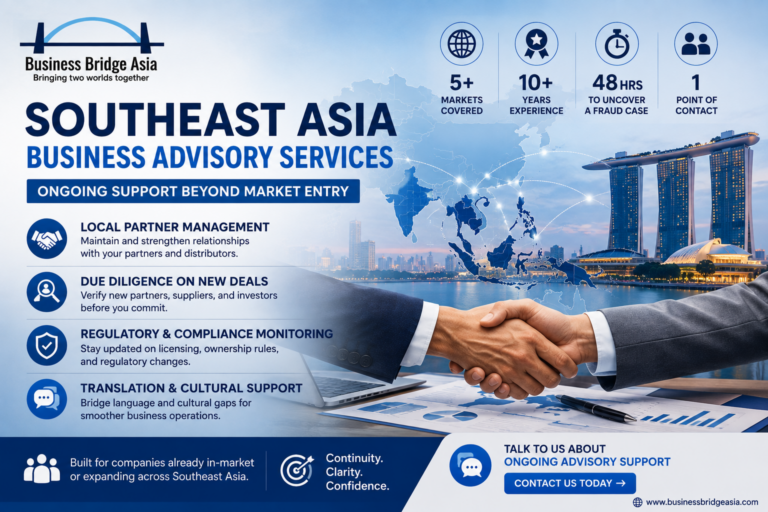
What services does ongoing Southeast Asia business advisory typically include? Ongoing Southeast Asia business advisory typically includes four areas: local partner and distributor management, due diligence on new partners or deals as they arise, regulatory and compliance monitoring as rules change, and translation and cultural training for teams working across markets. The scope grows with a company’s footprint in the region. |
When comparing providers, confirm whether their support ends at registration or continues through actual operations — the difference matters most once your business is live and dealing with day-to-day compliance and partner management.
When should a company use Philippines business expansion consulting?
Philippines business expansion consulting is typically most valuable after a company has validated initial demand and is deciding whether to scale operations, add a second location, or expand into new sectors within the country — rather than at first-entry stage, when market assessment services are more appropriate.
Local Partner Management — Maintaining and troubleshooting relationships with existing distributors and partners, not just introducing new ones.
Due Diligence on New Deals — Verifying any new partner, supplier, or investor before signing — see our full Asia Due Diligence Guide for the process.
Regulatory & Compliance Monitoring — Staying current with licensing and foreign ownership rules as they evolve, rather than discovering changes after they cause a problem.
Translation & Cultural Training — Ongoing document translation and staff training as teams and partnerships grow across markets.
Does business advisory work the same way across every Southeast Asia market?
No — while the core advisory areas are consistent, priorities shift by market. Vietnam advisory often centers on partner relationship management given the market’s relationship-driven culture. Singapore advisory often centers on regulatory and grant compliance. Indonesia advisory often centers on navigating provincial-level regulatory variation. A single advisory relationship across markets should adapt to these differences rather than applying one template everywhere.
For companies already operating in Vietnam market entry, our dedicated Vietnam Business Advisory Services guide covers what ongoing support looks like specifically for that market. We provide the same continuity for companies operating in Thailand market entry, Singapore market entry, and Indonesia market entry.
Why would a company choose ongoing advisory instead of hiring help only when needed?
Companies choose ongoing advisory because problems in Southeast Asia markets — a partner dispute, a new regulation, a due diligence red flag — tend to be time-sensitive, and an advisor already familiar with the company’s operations and local relationships responds faster than one starting from scratch on each new issue.
Companies expanding across two or three markets at once particularly benefit from a single advisory relationship rather than separate country-by-country contacts — it means one point of accountability across the whole regional footprint, not a fragmented set of vendors.
Business Bridge Asia clients include a US freight forwarding company that secured 100% ownership in the Philippines and Indonesia after another firm couldn’t, and a case where our Thailand-based team uncovered a fraudulent $9 million investment offer within 48 hours through local due diligence. Read the full real, sourced case studies.
Foreign direct investment into ASEAN markets has remained resilient even as global FDI flows have slowed, according to ASEAN Secretariat data — one reason ongoing local support has become more valuable as more companies maintain a longer-term regional presence rather than a single-market footprint.
Whether you’re operating in one Southeast Asia market or expanding across several, Business Bridge Asia can provide the continuity a series of one-off projects can’t.
Talk to Us About Ongoing Advisory Support → businessbridgeasia.com/contacts/