
What is Vietnam business advisory? Vietnam business advisory refers to ongoing professional consulting support that helps foreign companies operate successfully in Vietnam — including local partner matching, due diligence on suppliers and partners, regulatory and compliance guidance, and business document translation. Unlike a one-time market entry engagement, Vietnam business advisory typically continues throughout a company’s presence in the market, helping it navigate day-to-day operational, legal, and relationship challenges as they arise. |
Foreign companies exploring Vietnam business advisory services are often further along than those simply researching whether to enter the market — they are typically comparing specific advisors, evaluating what ongoing support looks like, and trying to understand which services they actually need. This guide is written for exactly that stage: it explains what Vietnam business advisory covers, how it differs from a one-time market entry engagement, and what to look for when choosing a partner.
Business Bridge Asia has supported foreign companies — including many US-headquartered businesses — through both initial Vietnam market entry consulting and ongoing advisory relationships across partner management, compliance, and local operations.
What services does a Vietnam business advisory firm provide?
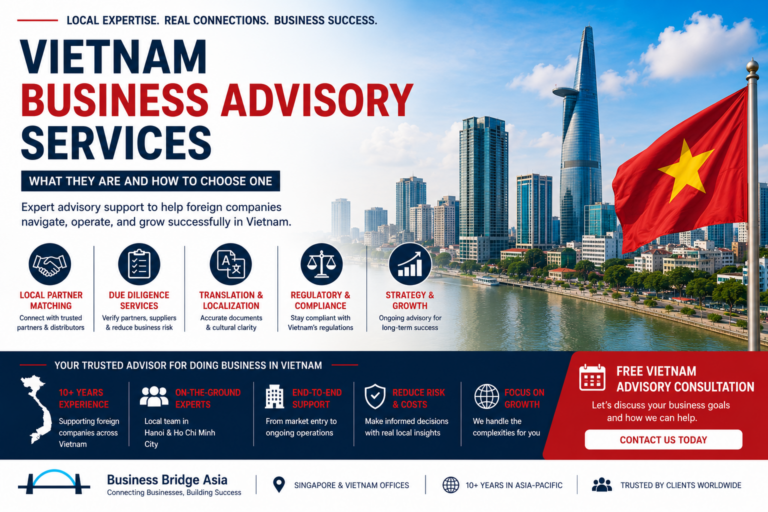
Vietnam business advisory services typically include four core areas: (1) local partner matching and relationship management, (2) due diligence on suppliers, distributors, and joint venture partners, (3) translation and localization of business and legal documents, and (4) ongoing regulatory and compliance guidance as local rules change. Together these services help a foreign company operate day-to-day in Vietnam without needing a large in-country team of its own.
Most foreign companies operating in Vietnam rely on local partners — distributors, manufacturing partners, or joint venture co-owners — to navigate relationships, regulations, and market access. Vietnam partner matching consulting connects foreign companies with vetted local partners suited to their industry and goals, rather than leaving them to search independently.
Companies researching how to find local partners in Vietnam typically underestimate how relationship-driven the process is — introductions and reputation matter as much as formal proposals, which is why an advisor with an existing local network is usually faster and lower-risk than a cold outreach approach.
Before signing an agreement with any Vietnamese partner, supplier, or distributor, Vietnam due diligence services verify business registration, financial standing, litigation history, and reputation using a network of local attorneys and researchers. This step is frequently skipped by companies moving quickly to close a deal — and is the step most often cited when a Vietnam partnership later runs into problems.
Contracts, regulatory filings, and day-to-day correspondence in Vietnam are conducted in Vietnamese. Vietnam translation services cover certified translation of legal and business documents as well as cultural training for staff working directly with Vietnamese counterparts — reducing the miscommunication risk that commonly derails early-stage partnerships.
Vietnam’s regulatory environment changes frequently, and regulatory challenges doing business in Vietnam — including licensing requirements, foreign ownership limits by sector, and import/export compliance — are among the most common reasons foreign companies engage an ongoing advisory relationship rather than handling compliance internally.
What is the difference between Vietnam market entry consulting and Vietnam business advisory?
Vietnam market entry consulting is a defined, time-bound engagement that helps a company plan and execute its initial entry into the Vietnamese market — market assessment, entity setup, and first partner introductions. Vietnam business advisory is broader and ongoing: it continues after entry to support day-to-day partner management, compliance, due diligence on new deals, and translation needs as the company’s presence in Vietnam grows.
Companies just beginning to research Vietnam market entry consulting should start with our dedicated guide, how to enter the Vietnam market, which covers entity structures, timelines, and first-step planning in full. This guide picks up from there — for companies that are either already in Vietnam or actively comparing advisory partners rather than deciding whether to enter.
How do I choose the right Vietnam business consultants?
When evaluating Vietnam business consultants, look for: (1) a local team based in Vietnam rather than consultants working remotely from another country, (2) direct experience in your specific industry, (3) an existing network of vetted local partners rather than a promise to ‘search’ after signing, (4) transparent fee structures rather than vague retainers, and (5) references from other foreign companies they have supported — ideally in a similar sector or company size.
Foreign companies evaluating Vietnam business consulting services often make the mistake of selecting a firm based primarily on price, without confirming the firm has genuine local presence and relationships. For doing business in Vietnam foreign company cases specifically, the quality of a consultant’s local network typically matters more than their global brand recognition.
If you are comparing consulting firms for vietnam market entry, Business Bridge Asia offers a free initial consultation to walk through your specific goals before you commit to any engagement.
What is the best Vietnam market entry strategy for SMEs?
For small and mid-sized companies, the most effective Vietnam market entry strategy typically involves starting with a local partner or distributor rather than establishing a wholly foreign-owned entity immediately. This reduces upfront capital commitment and regulatory complexity while allowing the company to validate demand. Once the partnership proves the market, SMEs can then evaluate whether to formalize a direct entity presence in Vietnam.
A sound Vietnam market entry strategy for SMEs balances speed with risk — moving fast enough to capture the opportunity, without overcommitting capital before the local relationships and regulatory picture are well understood. This is where a phased approach, starting with advisory support and a trial partnership, generally outperforms a large upfront investment for smaller companies with limited resources to absorb early missteps.
How do US companies get business advisory support for Vietnam?
US companies typically access Vietnam business advisory support either directly or by first establishing a Singapore entity as a regional base, then extending operations into Vietnam. Business Bridge Asia supports US companies with both approaches — direct Vietnam market entry, or a Singapore-hub structure for companies planning to operate across multiple Southeast Asian markets.
For Vietnam market entry consulting for US companies specifically, the most common friction points are US-Vietnam contract enforceability, understanding foreign ownership limits by sector, and structuring compensation for local hires. A Vietnam business advisory for US companies engagement typically addresses all three as part of the ongoing relationship, rather than as one-time setup items.
Should my Vietnam business advisor be based in Hanoi or Ho Chi Minh City?
The right city depends on your industry: Ho Chi Minh City is Vietnam’s commercial and manufacturing hub, better suited for consumer goods, retail, and manufacturing-focused companies. Hanoi is the political and administrative capital, better suited for companies needing close proximity to government ministries, licensing bodies, and state-owned enterprise partners. Many Vietnam business advisory firms, including Business Bridge Asia, maintain relationships across both cities to support either need.
Vietnam business consulting Hanoi Ho Chi Minh City comparisons come up often for companies deciding where to base their initial operations. As a general rule: if your business depends on licensing, permits, or government relationships, Hanoi proximity helps; if your business is consumer-facing or manufacturing-focused, Ho Chi Minh City’s commercial ecosystem is usually the stronger starting point.
Business Bridge Asia provides end-to-end Vietnam business advisory support, covering:
▸ Local Partner Matching — Introductions to vetted distributors, manufacturing partners, and joint venture candidates suited to your industry.
▸ Due Diligence — Verification of any Vietnamese partner, supplier, or distributor before you sign an agreement.
▸ Translation & Cultural Training — Certified document translation and staff training for working effectively with Vietnamese counterparts.
▸ Regulatory & Compliance Guidance — Ongoing support navigating licensing, foreign ownership rules, and import/export compliance as they evolve.
Just starting to evaluate Vietnam, or planning a wider Southeast Asia expansion? These guides cover the related topics:
▸ How to Enter the Vietnam Market — our complete first-entry guide covering entity setup, timelines, and initial partner introductions.
▸ How to Enter the Thailand Market — for companies evaluating Vietnam alongside neighboring Thailand.
▸ How to Enter the Indonesia Market — for companies planning a multi-market Southeast Asia strategy alongside Vietnam.
▸ Asia Market Entry Cost Guide 2026 — full pricing breakdown for market entry and advisory services across the region.
A: Vietnam business advisory fees vary based on scope — a one-time market entry engagement typically costs less than an ongoing advisory retainer covering partner management, due diligence, and compliance support. Most firms, including Business Bridge Asia, scope fees to the specific services required rather than a flat one-size-fits-all rate. A free consultation is the fastest way to get an accurate estimate for your situation.
A: It depends on your sector and structure. Some industries allow 100% foreign ownership, while others require a local joint venture partner by law. Even where not legally required, most foreign companies find a local partner significantly reduces the time and risk involved in navigating relationships, regulations, and market access in Vietnam.
A: Working with an advisory firm with an existing local network typically shortens this to a matter of weeks, compared to several months for companies searching independently — since introductions and vetting can happen in parallel rather than sequentially.
A: A market entry consultant typically supports a defined, time-bound entry project. A business advisor provides ongoing support after entry — partner management, due diligence on new deals, translation, and compliance — for as long as the company operates in Vietnam.
A: Yes. Vietnam business advisory firms with US-company experience typically support foreign ownership limit questions, licensing requirements, and import/export compliance as part of an ongoing advisory relationship, in addition to initial market entry setup.
Choose based on your industry rather than personal preference — Ho Chi Minh City suits consumer, retail, and manufacturing companies, while Hanoi suits companies needing close government and licensing-body proximity. Firms with a presence in both cities, like Business Bridge Asia, can support either need.
Whether you are comparing advisory partners, already operating in Vietnam, or planning your first entry, Business Bridge Asia can help — from partner matching and due diligence to ongoing compliance support.
Tell us about your Vietnam operations and we’ll respond within 24 hours — at no charge.
Free Vietnam Advisory Consultation → businessbridgeasia.com/contacts/
Schedule a Free Consultation → businessbridgeasia.com/contacts/