
What should I look for when choosing a Vietnam market entry consulting firm?
When evaluating consulting firms for Vietnam market entry, prioritize a firm with an actual team based in Vietnam, direct experience in your industry, an existing network of vetted local partners, transparent scope-based fees, and references from companies of a similar size. The right firm should also be clear about whether they handle one-time market entry, ongoing advisory support, or both — since many companies need one and assume they’re getting the other.
If you’re comparing consulting firms for Vietnam market entry, you’re likely past the research stage and into the decision stage — trying to figure out which firm will actually deliver, not just which country to enter. This guide covers the criteria that matter, the red flags to watch for, and the questions worth asking before you sign an engagement.
Does the choice of consulting firm really affect Vietnam market entry outcomes?
Yes — significantly. Vietnam’s regulatory requirements and partner landscape are consistent regardless of which firm you hire, but the quality of local relationships, the accuracy of due diligence, and the responsiveness of your consultant directly determine how smoothly entry goes. Two companies entering the same sector in Vietnam can have very different outcomes depending on the firm they chose.
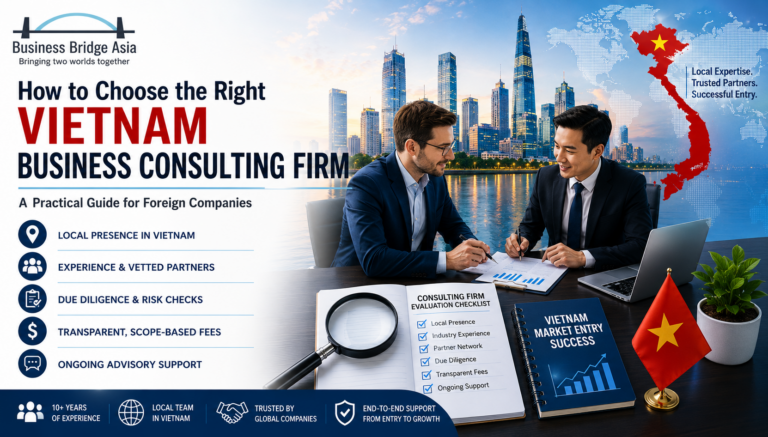
What are the most important criteria for choosing Vietnam market entry consultants?
The seven most important criteria are: (1) an actual team based in Vietnam rather than remote coverage, (2) direct experience in your specific industry, (3) an existing network of vetted local partners, (4) transparent, scope-based fees rather than vague retainers, (5) references from companies of a similar size and sector, (6) clarity on whether they offer one-time entry support, ongoing advisory, or both, and (7) responsiveness during the sales process itself — which is usually a preview of what working together will be like.
1. Local Presence in Vietnam — A firm operating out of Hanoi or Ho Chi Minh City, not just a regional Southeast Asia office, will typically have faster access to partners and more current knowledge of regulatory changes.
2. Industry-Specific Experience — Manufacturing, FMCG, and services each involve different partner networks and regulatory considerations — a generalist firm may not have the right contacts for your sector.
3. Existing Partner Network — Ask directly whether they already have vetted partners in your sector, or whether they would be starting the search after you sign.
4. Transparent, Scope-Based Fees — Fees should be tied to specific deliverables, not an open-ended monthly retainer with unclear scope.
5. Relevant References — References from a company similar in size and sector to yours are far more useful than a generic client list.
6. Entry vs. Advisory Clarity — Confirm upfront whether the engagement covers one-time market entry, ongoing advisory support, or both — see the next section for how these differ.
7. Responsiveness — How quickly and clearly a firm responds during the sales process is often a reliable preview of what working with them will actually be like.
What’s the difference between a Vietnam market entry consultant and a business advisory firm?
A Vietnam market entry consultant typically supports a defined, time-bound project — market assessment, entity setup, and first partner introductions. A business advisory firm provides ongoing support after entry — partner management, due diligence on new deals, translation, and compliance monitoring — for as long as the company operates in Vietnam. Some firms, including Business Bridge Asia, offer both, but it’s worth confirming which one you’re actually being sold.
If you’re still deciding whether to enter Vietnam at all, start with our guide on How to Enter the Vietnam Market. If you’ve already entered, or are past the planning stage and thinking about ongoing local support, our Vietnam Business Advisory Services guide covers what that ongoing relationship typically looks like.
Watch for these warning signs
A firm that quotes a flat fee before understanding your industry or entity structure, cannot name specific local partners they’ve worked with, has no team physically based in Vietnam, is vague about whether due diligence is included, or pressures you to sign quickly without a clear scope document — these are all signs worth pausing on before committing.
A firm that genuinely does due diligence work will also be comfortable explaining their own process in detail — if you’re unsure what to ask, our Asia Due Diligence Guide covers the same verification standards you should expect a consulting firm to apply on your behalf.
What questions should I ask before hiring a Vietnam market entry consultant?
Before hiring, ask: Do you have a team physically based in Vietnam? Can you name partners you’ve worked with in my industry? What does your fee cover, specifically? Is due diligence on partners included or a separate cost? Who will be my day-to-day point of contact? And what happens if the first partner introduction doesn’t work out?
▸Do you have a team physically based in Vietnam?
▸Can you name partners you’ve worked with in my specific industry?
▸What exactly does your fee cover, and what’s billed separately?
▸ Is due diligence on prospective partners included, or a separate engagement?
▸Who will actually be my day-to-day point of contact?
▸What happens if the first partner introduction doesn’t work out?
Business Bridge Asia offers both sides of the equation many companies end up needing separately:
▸ Local Team — Based in Singapore with active relationships across Vietnam, not a remote regional office.
▸ Both Entry and Advisory — One-time market entry support and ongoing business advisory, so you don’t need to switch firms as your needs evolve.
▸ Due Diligence Built In — Partner verification is a core service, not an afterthought — see our full Vietnam market entry consultants service page for scope and pricing.
▸ Scope-Based Fees — Pricing tied to what you actually need, not a flat retainer.
Evaluating a partnership alongside a broader market entry plan? These guides cover related topics:
▸How to Enter the Vietnam Market — for companies still deciding whether and how to enter.
▸ Asia Market Entry Cost Guide 2026 — full pricing breakdown including due diligence costs across the region.
▸Vietnam Business Advisory Services — for companies needing ongoing local support after entry.
▸Asia Due Diligence Guide — the verification standard any consulting firm should apply on your behalf.
A: Fees vary widely based on scope — a focused market assessment costs less than a full engagement covering entity setup, partner matching, and due diligence. Ask any firm for a scope-based quote rather than a flat number before comparing prices.
A: Yes, though not all firms offer both. Confirm this upfront if you expect to need ongoing support after initial entry — switching firms partway through can mean re-explaining your business and losing continuity.
A: A firm with an existing local network can typically make introductions within weeks. If a firm cannot estimate a timeline or says it depends entirely on starting a search after you sign, that’s worth questioning.
A: Much of the process — registration checks, financial record review, reference calls — can be done remotely. Physical verification of facilities, where relevant, typically requires an on-the-ground visit, which Business Bridge Asia coordinates through local teams.
A: Findings range from minor (outdated licensing paperwork) to serious (undisclosed litigation or financial instability). Business Bridge Asia presents findings clearly so you can decide whether to proceed, renegotiate terms, or walk away before any capital is committed.
A: It varies by firm — some include basic partner verification, others treat it as a separate service. Clarify this specifically before signing, since skipping due diligence is one of the most common and costly mistakes in Vietnam market entry.
A: Ask for references from companies in your industry and, where possible, speak with them directly rather than relying on testimonials alone. A firm confident in its relationships will typically be comfortable facilitating this.
Whether you’re comparing firms or ready to move forward, Business Bridge Asia can walk you through exactly what a Vietnam engagement with us would look like — no obligation.
Tell us about your Vietnam plans and we’ll respond within 24 hours.
Talk to a Vietnam Market Entry Specialist → businessbridgeasia.com/contacts/