
What is Cambodia market entry consulting?
Cambodia market entry consulting is professional advisory support that helps foreign companies plan and execute their entry into the Cambodian market — covering market assessment, entity registration, local partner matching, regulatory compliance, and due diligence. It typically spans everything from initial feasibility research through to on-the-ground execution, since Cambodia’s regulatory and business environment differs significantly from neighboring Vietnam or Thailand and often requires local relationships to navigate efficiently.
Foreign companies exploring Cambodia market entry consulting are usually drawn by Cambodia’s low labor costs, preferential trade access, and fast-growing manufacturing base — but the market rewards careful planning more than most of its neighbors. This guide covers everything a foreign company or SME needs to know before how to enter the Cambodian market: regulatory requirements, partner selection, entry strategy, and how to choose the right consulting partner.
Business Bridge Asia has supported foreign companies — including manufacturers, FMCG brands, and SMEs — through Cambodia due diligence, partner introductions, and full market entry execution across Phnom Penh, Sihanoukville, and Cambodia’s special economic zones.
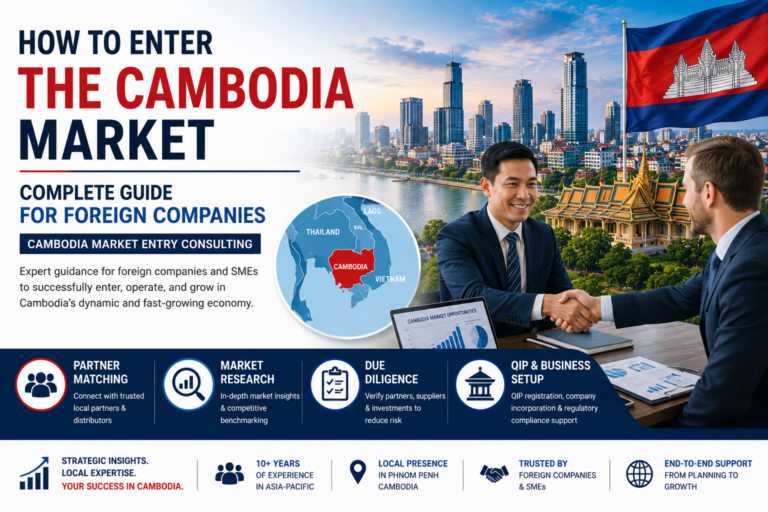
How do I enter the Cambodian market as a foreign company? Entering the Cambodian market typically involves four steps: (1) market assessment to validate demand and identify the right entry point, (2) choosing a legal structure — most foreign companies register a Private Limited Company or work through a Qualified Investment Project (QIP) for tax incentives, (3) securing a local partner or distributor where required by sector, and (4) registering with the Ministry of Commerce and relevant sector regulators. The full process typically takes 4-8 weeks with proper local support. |
Before committing capital, foreign companies should validate demand, competitive positioning, and the right entry channel — direct investment, distributor partnership, or a representative office — based on their sector and risk appetite.
Cambodia’s Qualified Investment Project (QIP) status, administered through the Council for the Development of Cambodia, offers tax holidays and import duty exemptions for qualifying foreign investments — but the application requires careful structuring to qualify, which is where most foreign companies underestimate the process.
What do foreign companies need to know about doing business in Cambodia? Foreign companies doing business in Cambodia should be aware of sector-specific foreign ownership limits (land ownership is restricted for foreign entities, though long-term leases and QIP structures provide workarounds), a bilingual Khmer-English contract requirement for enforceability, and a business culture that places significant weight on personal relationships and government-level introductions. Due diligence on any local partner or landlord is strongly recommended before committing capital. |
For doing business in Cambodia foreign companies specifically, land ownership restrictions are the most common source of confusion — foreign entities cannot directly own land, but long-term leases (up to 50 years, renewable) and QIP-qualifying structures provide practical alternatives that most first-time entrants aren’t aware of until well into the process.
How do I find a reliable local business partner in Cambodia?
Reliable Cambodia partner matching typically comes through an advisory firm with an existing local network, rather than independent searching — since reputation and personal introductions carry significant weight in Cambodia’s business culture. Due diligence on any prospective partner’s business registration, financial standing, and reputation should be completed before signing any agreement.
Business Bridge Asia’s Cambodia partner matching service connects foreign companies with vetted distributors, manufacturing partners, and joint venture candidates across Cambodia’s key sectors — reducing the months of independent searching that most companies otherwise face.
What is the best Cambodia market entry strategy for small and mid-sized companies?
For SMEs, the most effective Cambodia market entry strategy typically starts with a distributor or local partner arrangement rather than a full entity setup — reducing upfront capital and regulatory exposure. Once demand is validated, companies can evaluate whether to pursue QIP registration or a direct entity presence for tax efficiency and greater operational control.
Companies researching Cambodia business consulting for SMEs often assume Cambodia requires the same entry approach as Vietnam or Thailand — in practice, Cambodia’s smaller domestic market and QIP incentive structure typically reward a leaner, partner-led entry over a large upfront investment, particularly for companies testing the market before committing further.
How do I choose the right Cambodia business consulting services?
When evaluating Cambodia business consulting services, prioritize firms with an active presence in Phnom Penh (not just a regional Southeast Asia office), direct experience with QIP registration, an existing local partner network, and transparent, scope-based fees rather than open-ended retainers. References from other foreign companies in a similar sector are the strongest signal of genuine local capability.
Foreign companies comparing Cambodia business consulting services should be cautious of firms that quote a single flat fee without first understanding the sector and entity structure required — Cambodia’s QIP and land-lease frameworks mean the right approach varies significantly by industry.
Business Bridge Asia supports foreign companies with Cambodia market research and sector-specific consulting across:
▸Manufacturing — Site selection, QIP registration, and supply chain setup for Cambodia’s fastest-growing sector, including garment, electrical components, and light industrial manufacturing.
▸FMCG & Consumer Goods — Distribution partner matching and retail market entry for consumer brands entering Cambodia for the first time.
▸Retail — Market assessment and local partner identification for retail and franchise expansion into Phnom Penh and secondary cities.
▸M&A & Deal Execution — Target sourcing, due diligence, and deal execution support for companies acquiring or partnering with Cambodian businesses.
▸Market Research & Competitive Benchmarking — Demand validation, competitive landscape analysis, and pricing benchmarking ahead of market entry decisions.
▸Supply Chain — Sourcing and logistics partner identification for companies using Cambodia as a manufacturing or export base.
Business Bridge Asia provides end-to-end Cambodia market entry support, covering:
▸Market Assessment & Research — Demand validation and entry-point analysis before you commit capital.
▸Local Partner Matching — Introductions to vetted distributors, manufacturing partners, and joint venture candidates.
▸Due Diligence — Verification of any Cambodian partner, supplier, or landlord before you sign an agreement.
▸QIP & Entity Registration Support — Guidance through Council for the Development of Cambodia registration and tax incentive qualification.
Evaluating Cambodia alongside other Southeast Asia markets? These guides cover related topics:
▸ How to Enter the Vietnam Market — for companies comparing Cambodia against neighboring Vietnam.
▸ How to Enter the Thailand Market — for companies evaluating a multi-market Mekong region strategy.
▸Vietnam Business Advisory Services — for companies planning ongoing advisory support alongside market entry.
▸ Asia Market Entry Cost Guide 2026 — full pricing breakdown for market entry and advisory services across the region.
A: Costs vary by scope — a market assessment alone typically costs less than a full engagement covering partner matching, due diligence, and QIP registration support. Most firms, including Business Bridge Asia, scope fees to the specific services required. A free consultation is the fastest way to get an accurate estimate.
A: It depends on your sector. Some industries allow full foreign ownership, particularly under QIP status, while others — including land-related activities — require a local partner or long-term lease structure. Even where not legally required, a local partner significantly reduces the time needed to navigate relationships and market access.
A: A Qualified Investment Project (QIP) is a status granted by the Council for the Development of Cambodia that provides tax holidays and import duty exemptions for qualifying investments. It isn’t required for all businesses, but manufacturing and export-oriented companies typically benefit significantly from QIP registration.
A: Cambodia has a smaller domestic market than Vietnam or Thailand, but offers lower labor costs, QIP tax incentives, and a more relationship-driven business culture. Foreign companies often find a leaner, partner-led entry strategy works better in Cambodia than the direct-entity approach common in larger neighboring markets.
A: Foreign entities generally cannot directly own land in Cambodia, but long-term leases (up to 50 years, renewable) and QIP-qualifying investment structures provide practical alternatives commonly used by foreign manufacturers and investors.
Standard business registration with the Ministry of Commerce typically takes a few weeks, while QIP registration through the Council for the Development of Cambodia can extend the timeline depending on the sector and documentation required. Working with an experienced local advisor typically shortens this process.
Whether you’re assessing the Cambodian market for the first time or ready to register a QIP and find a local partner, Business Bridge Asia can help — from market research to on-the-ground execution.
Tell us about your Cambodia plans and we’ll respond within 24 hours — at no charge.
Free Cambodia Market Entry Consultation → businessbridgeasia.com/contacts/
Schedule a Free Consultation → businessbridgeasia.com/contacts/