
What is Asia market entry consulting?
Asia market entry consulting is advisory support that helps foreign companies plan and execute their expansion into Asia-Pacific markets — covering market assessment, local partner matching, entity setup, and regulatory navigation, typically delivered by a firm with an existing on-the-ground presence in the target country.
If you’re evaluating Asia market entry consulting providers, you’re likely past the question of whether to expand and into the harder question of who to trust with it. This guide breaks down what these services actually cover, what separates a strong advisory partner from a weak one, and what to expect market by market across Asia-Pacific.
What services are included in Asia market entry consulting? Asia market entry consulting typically covers four core areas: market assessment and feasibility research, local partner or distributor matching, entity registration and regulatory navigation, and initial due diligence on prospective partners. The exact scope varies by firm — some stop at market assessment, while others carry a client through to on-the-ground execution and ongoing advisory support. |
The breadth of what’s included varies more between firms than the underlying market research itself — which is exactly why the choice of partner matters more than most companies initially expect.
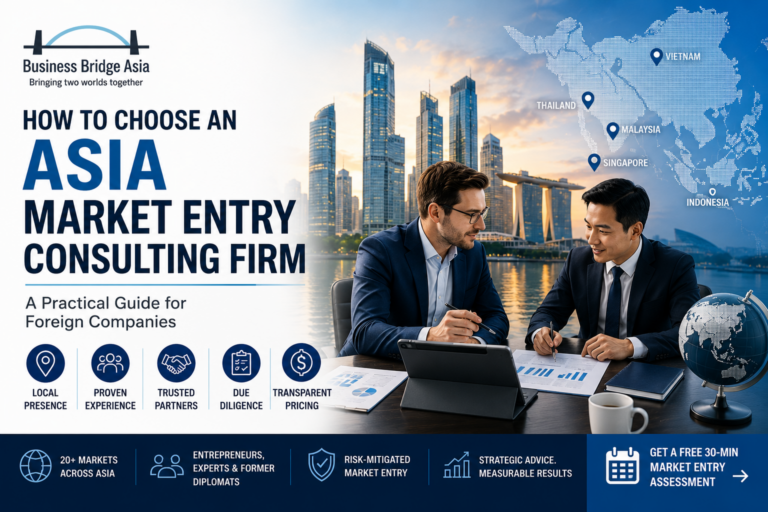
What should I look for in an Asia market entry advisory firm? Look for genuine local presence rather than remote coverage, direct experience in your target country and industry, a track record of successful partner introductions, transparent scope-based pricing, and clarity on who specifically will be advising you — their background and expertise, not just the firm’s brand. |
1. Local Presence vs. Remote Advice — A firm with an actual team in-market typically has faster access to partners and more current regulatory knowledge than one advising remotely from another region.
2. Country-Specific Experience – Market entry in Vietnam, Thailand, and Indonesia each involve different regulatory frameworks and partner landscapes — ask specifically about experience in your target country, not just “Asia” broadly.
3. Partner Matching Track Record – Ask for examples of partner introductions that led to signed agreements, not just a general claim of “local relationships.”
4. Transparent Pricing – Fees should be scoped to specific deliverables. Be cautious of firms quoting a flat rate before understanding your industry, target country, or entity structure.
5. Who Are the Consultants?
The individuals advising you matter as much as the firm’s name. Ask about the specific backgrounds of the people who would be working on your account — regional experience, language capability, and prior sector work.
What does Vietnam market entry advisory typically involve?
Vietnam market entry advisory typically covers entity structure selection, local partner introductions, and navigating Vietnam’s regulatory requirements — a process that usually benefits from strong local relationships given how much of Vietnam’s business culture runs on introductions and reputation rather than cold outreach.
For a deeper look at evaluating specific providers, see our guide on consulting firms for Vietnam market entry, and our Vietnam market entry advisory service page for full scope and pricing.
How does market entry advisory differ across Southeast Asia?
While the core process — market assessment, partner matching, entity setup — is similar across Southeast Asia, the regulatory environment, timeline, and partner landscape differ meaningfully by country. Thailand, Indonesia, Malaysia, and Singapore each have distinct foreign ownership rules and entry timelines worth understanding before assuming a one-size-fits-all approach.
For country-specific detail, see our guides on How to Enter the Thailand Market, How to Enter the Indonesia Market, How to Enter the Malaysian Market, and Singapore as Asia Pacific business hub for companies considering Singapore as a regional base.
What mistakes do companies make when hiring an Asia market entry consultant?
The most common mistakes are choosing a firm based on price alone without confirming local presence, assuming one firm’s Asia-wide experience applies equally to every country, skipping reference checks with similar-sized companies, and not clarifying upfront whether due diligence on partners is included in the scope or billed separately.
▸Choosing on price alone: The cheapest quote often reflects a narrower scope — confirm exactly what’s included before comparing numbers across firms.
▸Assuming broad “Asia experience” transfers country to country: A firm strong in Singapore incorporation isn’t automatically strong in Vietnamese partner relationships — ask about the specific country, not the region.
▸Skipping reference checks: A polished pitch deck says little about execution — a 15-minute call with a past client of similar size usually reveals more.
▸Not clarifying due diligence scope upfront: Some firms include partner verification by default; others treat it as a separate paid add-on. Ask before signing, not after.
Business Bridge Asia is built by entrepreneurs, subject matter experts, and former diplomats, with local presence across 20+ Asia-Pacific markets — not a single regional office covering the whole continent remotely. Engagements typically start from $2,500 depending on scope, and every engagement includes an Asia Due Diligence Guide-standard verification of any partner we introduce you to — not offered as a separate add-on.
▸ Former Diplomats on Staff — Regulatory and political-risk perspective most consulting firms don’t have in-house.
▸ Local Offices, Not Remote Coverage — Teams actually based in the markets we advise on, not a single Asia-wide desk.
▸ Due Diligence Built Into Every Engagement — Partner verification as standard practice, not an upsell.
▸ Scope-Based Pricing From $2,500 — Fees tied to what you actually need, disclosed upfront.
A: Costs typically start from around $2,500 and scale with scope — market assessment alone costs less than a full engagement covering partner matching, entity setup, and due diligence. Ask any firm for a scope-based quote rather than a flat number.
A: Timelines vary by country and structure, but most engagements move from initial assessment to first partner introductions within 4-8 weeks when working with a firm that has an existing local network.
A: A firm with an actual in-market team typically has faster access to partners and more current regulatory knowledge than one advising remotely — this matters more in relationship-driven markets like Vietnam and Indonesia than in more standardized markets like Singapore.
A: The terms are often used interchangeably. Where a distinction exists, “consulting” tends to refer to a defined, time-bound project, while “advisory” can imply an ongoing relationship — confirm which one a specific firm is offering rather than assuming based on terminology alone.
A: Singapore is generally considered the most straightforward for company registration and regulatory clarity, which is why many foreign companies use it as a regional hub before expanding into markets like Vietnam, Thailand, or Indonesia.
A: Ask for references from companies of a similar size and industry to yours, and speak with them directly where possible. A firm confident in its track record will typically be comfortable facilitating this.
Whether you’re comparing providers or ready to move forward, we’ll walk through your specific expansion plans and what a Business Bridge Asia engagement would actually look like — no obligation.
Get a Free 30-Min Market Entry Assessment → businessbridgeasia.com/contacts/